Why this blog is called "Gallimaufry".

gal-uh-MAW-free\, noun.

Originally meaning "a hash of various kinds of meats," "gallimaufry" comes from French galimafrée; in Old French, from the word galer, "to rejoice, to make merry"; in old English: gala + mafrer: "to eat much," and from Medieval Dutch maffelen: "to open one's mouth wide."

It's also a dish made by hashing up odds and ends of food; a heterogeneous mixture; a hodge-podge; a ragout; a confused jumble; a ridiculous medley; a promiscuous (!) assemblage of persons.

Those of you who know me, will, I’m sure, understand how well some of these phrases (barring the "promiscuous" bit!) fit me.

More importantly, this blog is an ode to my love for Shimla. I hope to show you this little town through my eyes. If you don't see too many people in it, forgive me, because I'm a little chary of turning this into a human zoo.

Stop by for a spell, look at my pictures, ask me questions about Shimla, if you wish. I shall try and answer them as best as I can. Let's be friends for a while....

Showing posts with label Himachal flowers. Show all posts

21 August 2010

Pleasures are like poppies spread, You seize the flow'r, its bloom is shed...

The road which leads from Bairagarh to Satrundi and onwards to Sach Pass in Himachal's Chamba district is a truly magical one. Early morning mist renders the scenery like a scene out of a Basho haiku. Other times, it feels like an expertly-etched sumi-e painting.
The velvety grey of the sky is relieved by the chartreuse, the moss, the viridian and the beryl of the trees which line both sides and dot the hillside. The true delight for me came from the innumerable species of wild flowers which spring up in the rainy season.
I spotted a blue poppy!
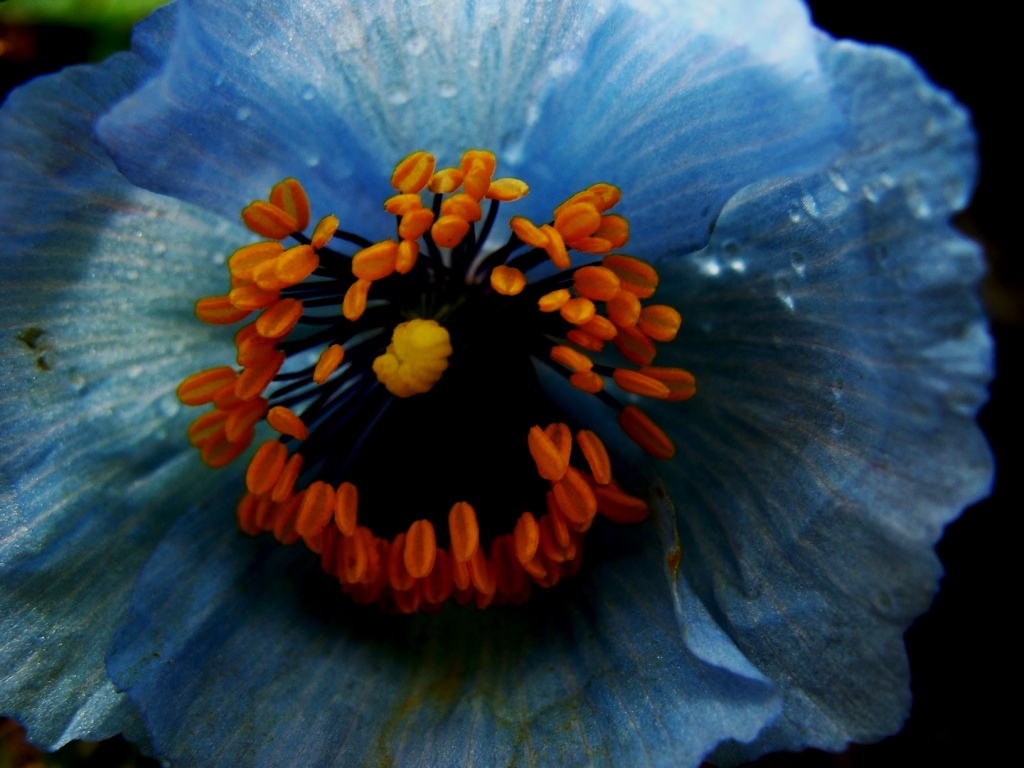


Flowers of the meconopsis genus of the Papaveraceae species are often mistakenly lumped by the common name of blue Himalayan poppy. However, like the holy Roman empire which was neither holy, nor Roman, nor completely an empire, a blue Himalayan poppy is not always blue and certainly not found in the Himalayas alone.
The one that I found would probably fall in the meconopsis acculeata category, being the only one of its family to be found at such a high altitude. Legend has it that the legendary climber Mallory first spotted it in Bhutan and carried a plant back to the United Kingdom after his famous failed attempt to climb the Mount Everest. It is therefore appropriate to mention that this is the national flower of Bhutan.


The genus comprises of 45 to 50 known species and almost all are native to the Himalayan region. Some may occur in lower but nonetheless montane altitudes. They are found from central Nepal to the Tibetan plateau, from China to Kashmir and Himachal Pradesh.
The flowers were about 5 to 7 centimetres across, with four almost rounded petals. I found the golden yellow stamen-filaments to be a wonderful contrast to the pale blue petals. The petals were paper thin, water seemed to run off them speedily, which was just as well, considering how heavily it rains in the Pangi region. The leaves (not visible in these photographs) grow in a sort of rosette, and are widely-spaced and pinnate in shape. The stem of this herbaceous perennial has bristly hair. The blue poppy was found growing in well-drained, but sunny spots and rocky crevices.
This wonderful, show-stopper of a flower is commonly known as Vanita (वनिता) in Hindi and as gul-e-neelam ( गुल-ए-नीलम) in Urdu. So rare has it become that I feel it was a divine blessing to have been able to see it with my own eyes.


3 August 2010

The motion of light, spills itself in astonished seed

I dragged myself away from beloved Shimla recently. Favourite fellow-traveller and good friend SdS and I went gallivanting over the hills from Kangra to Chamba to Lahaul to Kullu. Over hill and dale, past many a waterfall, it was a marvellous journey. I leave it to SdS to tell that tale since she does it far far better than anyone else in our circle of acquaintance.
En route from Chamba to Lahaul falls that magical place called Pangi Valley. Its beauty deserves not just a blog post, but perhaps an entire book, and even so words will not ever be able to describe, nor any camera be able to really capture the bounty that Nature lays out before human eye.
SdS and I stopped innumerable times to smell the flowers, so to speak. For a flower-lover Pangi is a treasure trove, and more so in the monsoons when many rare flowers bloom for a short while only to disappear for a whole year until the rains arrive the next time.

So, somewhere between Bairagarh and Satrundi, on a path unknown, this bright yellow bouquet caught my eye. Growing in a tight tuft, there was a cluster of leaves at the base of this plant. Its stem was delicate but erect. The flowers grew in an interesting, interlaced arrangement, as you can see above. They were about 2 to 2.5 cms in length including a spur that was half as long, growing straight or in a gentle downwar curve.
My vade mecum, Polunin and Stainton, tells me that the name of this plant is Corydalis govaniana Wall, Family fumariacaea. My entourage (which excludes SdS!) told me it is locally known as "bhutjata" "bhutakesi" or "bhutbishi". I also found this flower being referred to as "Govan's Fumitory".


A common alpine species, corydalis govaniana is usually found at a height of 2400m to 4800m on open slopes. Narain Singh Chauhan in his book "Medicinal and Aromatic Plants of Himachal Pradesh" says he has found these along places as disparate as Rohtang, Churdhar and Lahaul.


The leaves are radical, growing in a dense tuft and reminded me of those belonging to the marigold plant, or even coriander. They were clustered at the base of the plant. The stem arose from the centre of this bunch.
The root and juice of this plant have several uses. These range from the cure of dandruff to the use of the juice as a diuretic. Interestingly, I found citations in the US Food and Drug Administration daabase which state list Corydalis govaniana as a poisonous plant. (Ref: FDA #F05964, GRIN #11624). The Indian Journal of Experimental Biology also includes this plant in its acute toxicity data. Amazing, that a flower so beautiful should have beneficial powers and at the same time be so toxic!

28 June 2010

The very form, the very scent, not heavy, not sensuous, but perilous perilous of orchids


I've been meaning to make a post on orchids for a while now. Say the word and you get a range of intriguing reactions from people. It goes from outright delight and wonderment to sheer aversion. William Faulkner goes so far as to say "Nasty things. Their flesh is too much like the flesh of men, their perfume has the rotten sweetness of corruption."


Personally, I am enamoured by their complexity and diversity and above all, their cosmopolitanism! They appear in almost every sort of habitat you can think of. Excepting glaciers and deserts, of course. The largest number of species occurs in the tropics, but is followed closely by countries in the temperate region. Very few orchid-lovers know the startling fact that the number of orchid species is almost twice that of bird species and almost four times the mammal species.


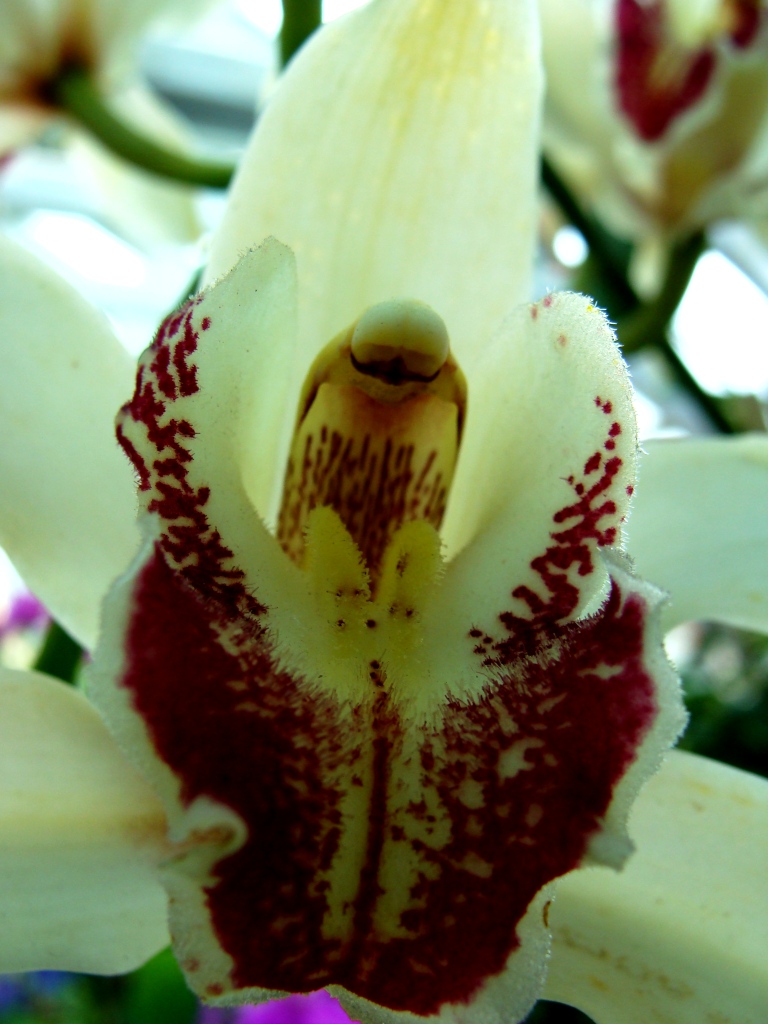
In my hunt for orchids to photograph, I found interesting variation, which I'm going to illustrate in my deeply unscientific fashion. I found two whorls: an outer one with three sepals and an inner one with three petals. The upper medial petal appeared to be much more enlarged and modified, perhaps to aid pollination. There are three stamens whose filaments appeared fused or joined to my untrained eye.


Reading up about orchids, I cam across some interesting facts. Like the one that everyone's favourite flavour, vanilla, is an orchid genus. Or that orchids are used for making hot beverages, for flavouring ice cream and even rum! In Turkey, certain species of orchids are considered to have aphrodisiac powers.


Here in Shimla, I've found the prettiest orchids being grown by Shri Mela Ram Sharma for the Indian Institute of Advanced Study. My friend R's venerable father-in-law also grows gorgeous ones. Orchids which he's brought from Sikkim and Meghalaya and which, miraculously, survive the heat and humidity of Sunni.

For the detail-minded reader, some limited information:
Kingdom: Plantae
Order: Asparagales
Family: Orchidacaea


10 June 2010

Thou blushest from the painter's page, Robed in the mimic tints of art...


Still, still my eye will gaze long fixed on thee,
Till I forget that I am called a man,
And at thy side fast-rooted seem to be,
And the breeze comes my cheek with thine to fan,
Upon this craggy hill our life shall pass,
A life of summer days and summer joys,
Nodding our honey-bells mild pliant grass,
In which the bee half hid his time employs,
And here we'll drink with thirsty pores the rain,
And turn, dew-sprinkled, to the sun,
And look when in the flaming west again,
His orb across the heaven its path has run;
Here left in the darkness on the rocky steep,
My weary eyes shall close like folding flowers in sleep.
~ Jones Very ~


I spotted Columbines in the woods of Sheogh in June last year, thanks to Dr. Suresh Nair. This year, they were closer at hand in Sanjiv's lovely garden. In Sheogh, I found it growing in partial shade, whereas at Sanjiv's place, it grows in full sunlight. Its height in both places was about 15 to 20 inches. Sanjiv says the plant is partial to a well-drained soil, but is hardy enough not to require mulching or protection in the winter. She informs that she propagates it by seed.
Elegantly formed and coloured in shades of lilac, violet and white, this flower is very easy to distinguish because of its five backward projecting spurs of the inner petals. A row of inner and outer petals form the columbine, which grows at a 90-degree angle to its stem. The leaves appeared similar to ferns to my untrained eye.
The botanical name of the columbine Aquilegia comes from the Latin word aquila, an eagle, perhaps, in reference to the claw-like spurs which grow at the back of the flower. The name columbine comes from columba, a dove.

Scientific details:
Kingdom: Plantae
Division: Magnoliophyta
Class: Magnoliospida
Order: Ranunculales
Family: Ranunculaceae
Genus: Aquilegia


8 August 2007

Edelweiss! Edelweiss!

Edelweiss, edelweiss,
every morning you greet me.
Small and white, clean and bright,
you look happy to meet me.
Blossom of snow, may you bloom and grow,
bloom and grow forever.
Edelweiss, edelweiss,
bless my homeland forever.


There is little of Tyrol in Spiti, except a tiny distant cousin made immortal by Richard Rodgers and Oscar Hammerstein in The Sound Of Music. I found this woolly little flower blooming in abundance beyond Kunzum La, the faces of its star-shaped flowers open to the sun & nodding contentedly in that semi-arid soil.

Related Posts with Thumbnails