Why this blog is called "Gallimaufry".
gal-uh-MAW-free\, noun.
Originally meaning "a hash of various kinds of meats," "gallimaufry" comes from French galimafrée; in Old French, from the word galer, "to rejoice, to make merry"; in old English: gala + mafrer: "to eat much," and from Medieval Dutch maffelen: "to open one's mouth wide."
It's also a dish made by hashing up odds and ends of food; a heterogeneous mixture; a hodge-podge; a ragout; a confused jumble; a ridiculous medley; a promiscuous (!) assemblage of persons.
Those of you who know me, will, I’m sure, understand how well some of these phrases (barring the "promiscuous" bit!) fit me.
More importantly, this blog is an ode to my love for Shimla. I hope to show you this little town through my eyes. If you don't see too many people in it, forgive me, because I'm a little chary of turning this into a human zoo.
Stop by for a spell, look at my pictures, ask me questions about Shimla, if you wish. I shall try and answer them as best as I can. Let's be friends for a while....
12 October 2010
Through the silence shines a stretching light-
9 September 2010
Now that I have your heart by heart, I see.

What the heart of the young man said to the psalmist
Tell me not, in mournful numbers,
Life is but an empty dream! --
For the soul is dead that slumbers,
And things are not what they seem.
Life is real! Life is earnest!
And the grave is not its goal;
Dust thou art, to dust returnest,
Was not spoken of the soul.
Not enjoyment, and not sorrow,
Is our destined end or way;
But to act, that each to-morrow
Find us farther than to-day.
Art is long, and Time is fleeting,
And our hearts, though stout and brave,
Still, like muffled drums, are beating
Funeral marches to the grave.
In the world's broad field of battle,
In the bivouac of Life,
Be not like dumb, driven cattle!
Be a hero in the strife!
Trust no Future, howe'er pleasant!
Let the dead Past bury its dead!
Act, -- act in the living Present!
Heart within, and God o'erhead!
Lives of great men all remind us
We can make our lives sublime,
And, departing, leave behind us
Footprints on the sands of time;
Footprints, that perhaps another,
Sailing o'er life's solemn main,
A forlorn and shipwrecked brother,
Seeing, shall take heart again.
Let us, then, be up and doing,
With a heart for any fate;
Still achieving, still pursuing,
Learn to labor and to wait.
~ Henry Wadsworth Longfellow ~
28 June 2010
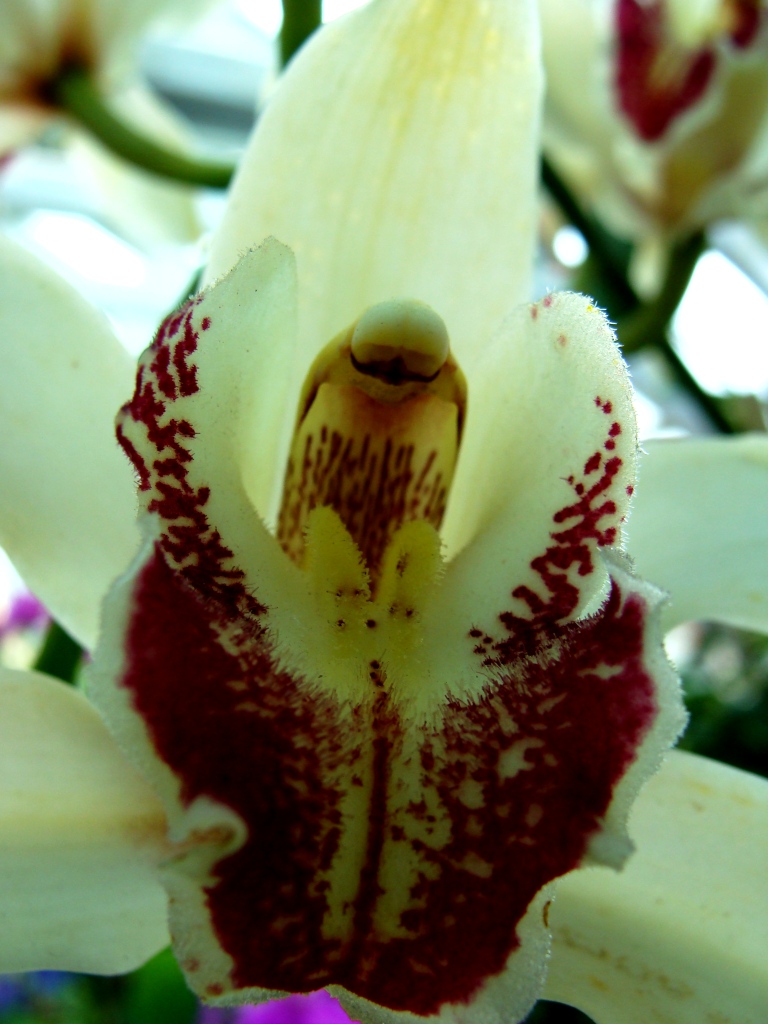
The very form, the very scent, not heavy, not sensuous, but perilous perilous of orchids
10 June 2010
Thou blushest from the painter's page, Robed in the mimic tints of art...
3 April 2010
Embrace your solitude... and try to sing out with it.
29 March 2010
The smallest flower is a thought...
Also called "winter cherry", abutilon megapotamicum is a species native to Uruguay, Brazil and Argentina. The shrub I spotted in Sanjiv's garden is about 2 metres in height. The leaves are dark green, palmate, with a heart shape at the base. The buds resembled a fat red paper lantern. The fully-bloomed flower had five petals, these are actually enlarged sepals that have fused together to envelop the forming fruit. The fruit, resembling a cherry tomato., had a shiny skin , its flesh embedded with a rich harvest of seeds.
Some scientific details:
Kingdom: Plantae
Order: Malvales
Family: Malvaceae
Genus: Abutilon
Species: Megapotamicum
22 March 2010
Just living is not enough, one must have sunshine, freedom, and a little flower.
Antirrhinum is a genus of plants commonly known as snapdragons from the flowers' fancied resemblance to the face of a dragon that opens and closes its mouth when laterally squeezed (thus the 'snap'). As a child, I loved to pinch the tiny individual blossoms and make the "dragon mouth" open and close.For the detail-minded among my gentle readers:
Kingdom: Plantae
Order: Lamiales
Family: Plantaginaceae
Genus: Antirrhinum
20 March 2010
Thou unassuming Commonplace Of nature, with that homely face...
13 March 2010
On the stem Of memory imaginations blossom.
And all the seasons of snows and sins;
The days dividing lover and lover,
The light that loses, the night that wins;
And time remembered is grief forgotten,
And frosts are slain and flowers begotten,
And in green underwood and cover
Blossom by blossom spring begins.
~ A.C. (Algernon Charles) Swinburne ~
4 October 2009
Clematis and cabbage.
Walking in the Sheogh woods is ever a pleasure. Every month reveals fickle bugs and capricious flora. A little velvety starlet which caught your eye in March vanishes in September. That little black spiny fellow who went scampering under a bush in May goes off for his winter vacation and will only put in an appearance next year. Still, in the spirit of gathering ye flowers while ye May, one ventures back into the forest over and over again; unfailingly treated to some new species each time.
This time, I discover Clematis connata.

This is pretty lemon-coloured, bell-shaped flower about an inch long. It is mildly fragrant. It had four long petals that curve outwards and are finely woolly-haired when seen up close. The anthers are creamy green and the leaves, a glossy green pinnate. The flowers are hermaphrodite (have both male and female organs) and are pollinated by bees and flies. I found the flowers growing in warm, sunny, yet sheltered spots. The soil looked moist, but well-drained. The leafstalks had wrapped themselves around twigs and branches for support.
Fair crown of stars of purest ray,
Hung aloft on Mapau tree,
What floral beauties ye display,
Stars of snowy purity;
Around the dark-leaved mapau's head
Unsullied garlands ye have spread.
Concealed were all thy beauties rare
'Neath the dark umbrageous shade,
But still to gain the loftiest spray,
Thy weak stem its efforts made;
Now, every obstacle o'ercome,
Thou smilest from thy leafy home.
That home secure, 'mid sombre leaves
Yielded by thy stalwart spouse,
Helps thee to show thy fairy crown,
Decorates his dusky boughs:
His strength, thy beauty, both unite
And form a picture to delight.
Fair flower, methinks thou dost afford
Emblem of a perfect wife,
Whose work is hidden from the world,
Till, perchance, her husband's life
Is by her influence beautified,
And this by others is descried.
---
The humble cabbage is native to the Mediterranean and was known to the Greeks and Romans, even finds place in Cato's writings. Then man, it seems, praised it for its medicinal value and called it a vegetable that "surpasses all vegetables"! This is a herbaceous, biennial plant which is a great source of Vitamin C and riboflavin and contains significant quantities of glutamine, an amino-acid which has anti-inflammatory properties.This leads me to conclude that some truths, no matter how unattractive, may actually be good for you!
23 September 2009
An attitude of gratitude
- Friends. Those of you who stuck by me and those of you who went away. Those of you I've known for long and those of you I've only just met. You make my life richer by your presence.
- Family which gives and gives me only support and affection, pulls my leg when I act too stuffy, and does not indulge in guilt trips. Just lets me be.
- Good health, pronounced as 200% fitness by those in the know.
- A job which lets me travel and fool around and meet interesting people and do worthwhile stuff.
- A creative space which is my solace when all else goes downhill.
- Internet through which I've met some amazing people and made friends with them although they live miles and miles away.
- Shimla where I feel most centred and creative and content.
"Do you give thanks for this? -- Or that?"
No, God be thanked
I am not grateful
In that cold calculating way, with blessing ranked
As one, two, three, and four -- that would be hateful.
I only know that every day brings good above
My poor deserving;
I only feel that, in the road of Life, true love
Is leading me along and never swerving.
Whatever gifts and mercies in my lot may fall,
I would not measure
As worth a certain price in praise, or great or small.
But take them and use them all with simple pleasure.
~ Henry Van Dyke ~
14 August 2009
I found that essence rare...
Tucked into the retaining wall was this small plant. Its height could not have been more than 30 centimetres. The plant had long, stalkless, tuber type flowers. The flowers looked peculiar because while their petals were white crescent shapes, the sepal was pale green in colour. The length was, by my educated guess, around 20 to 24 milimetres. There were three leaves about 6 to 8 centimetres long. We were unable to identify the flower. This is where the good people at Flowers Of India came to our aid. They identified it as Habenaria Intermedia, of the orchidaceae family. In plain English this means this is a type of orchid!
Further reading lead me to the research conducted by R. S. Chauhan and others. The most disturbing aspect pointed out by these scholars is that Habenaria intermedia is rapidly disappearing due to indiscriminate digging for its edible tubers. The scientists report that this species forms an important constituent of the Indian traditional schools of medicine for preparing a rejuvenating tonic much popular with Indians - "chyawanprash". Apparently, a destructive and indiscriminate system of harvvesting this delicate plant is resulting in its gradual disappearance. A minor catastrophe.
This Robert Frost poem describes our day so well....
Once on the kind of day called "weather breeder",
When the heat slowly hazes and the sun,
By its own power seems to be undone,
I was half boring through, half climbing through
A swamp of cedar. Choked with the oil of cedar
And scurf of plants, and weary and over-heated,
And sorry I ever left the road I knew,
I paused and rested on a sort of hook
That had me by the coat as good as seated
And since there was no other way to look
Looked up toward heaven, and there against the blue
Stood over me a resurrected tree,
A tree that had been down and raised again -
A barkless spectre. He had halted too,
As if for fear of treading upon me.
I saw the strange position of his hands -
Up at his shoulders, dragging yellow strands
Of wire with something in it from men to men.
"You here?" I said. "Where aren't you nowadays
And what's the news you carry - if you know?
And tell me where you're off for - Montreal?"
"Me? I'm not off anywhere at all.
Sometimes I wander out of beaten ways
Half looking for the orchid Calypso".
9 August 2009
Wild flowers don't care where they grow....
The picture of the strawberry, incidentally, was taken in June this year. Reminds me of Kipling's words: "Red jewels warm / from Nature's heart".
16 July 2009
Jack-in-the-pulpit
It emits a smell not unlike that putrefying flesh, which is most unattractive. I was, therefore, mystified to find insects trying to crawl into the cavernous mouth of an Arisaema flower. A Botany maven then informed that certain types of insects are actually attracted to this foul scent and will go into the flower looking for easy pickings on the dead flesh of some animals. Arisaema cleverly imitates this stench, and once the unsuspecting insect walks into its flower, it (the insect) gets stuck in the slightly sticky substance inside the flower.
The ones seen last year were light green all over, whereas this year, two ore interesting types seem to have sprung up. One is of the palest green with dark green stripes. The other, has violet, almost brown stripes. I find this a bit like describing the colour of a zebra: is it white with black stripes? Or black with white ones?! A learned Botany type tells me that some scientists classify these as three variations of the one species, whereas others say these are three distinct species! At any rate, they all belong to the magnoliophyta (flowering plant) division, and to the liliopsida class.
A little later last year, I was also fortunate enough to be to photograph the fruit of Jack-in-the-pulpit. I little knew that this cluster of shiny berries was a part of the same plant I'd condemned as being rather unsightly earlier! The fruit is smooth, shiny green and about a centimetre in diametre. It begins to turn bright red before the plant goes dormant in winter.
The dangerous aspect of Arisaema cannot be emphasised enough. The presence of calcium oxalate crystals can cause of the mouth and digestive system, and on rare occasions, the swelling of the mouth and throat may be severe enough to affect breathing.
5 July 2009
The spiral is a spiritualised circle...
Like a wheel within a wheel
Never ending or beginning
On an ever-spinning reel
Like a snowball down a mountain
Or a carnival balloon
Like a carousel thats turning
Running rings around the moon
Like a clock whose hands are sweeping
Past the minutes of its face
And the world is like an apple
Whirling silently in space
Like the circles that you find
In the windmills of your mind
Like a tunnel that you follow
To a tunnel of its own
Down a hollow to a cavern
Where the sun has never shone
Like a door that keeps revolving
In a half-forgotten dream
Or the ripples from a pebble
Someone tosses in a stream
Like a clock whose hands are sweeping
Past the minutes of its face
And the world is like an apple
Whirling silently in space
Like the circles that you find
In the windmills of your mind
Keys that jingle in your pocket
Words that jangle in your head
Why did summer go so quickly?
Was it something that you said?
Lovers walk along a shore
And leave their footprints in the sand
Is the sound of distant drumming
Just the fingers of your hand?
Pictures hanging in a hallway
And the fragment of a song
Half-remembered names and faces
But to whom do they belong?
When you knew that it was over
You were suddenly aware
That the autumn leaves were turning
To the colour of her hair
Like a circle in a spiral
Like a wheel within a wheel
Never ending or beginning
On an ever-spinning reel
As the images unwind
Like the circles that you find
In the windmills of your mind