Why this blog is called "Gallimaufry".

gal-uh-MAW-free\, noun.

Originally meaning "a hash of various kinds of meats," "gallimaufry" comes from French galimafrée; in Old French, from the word galer, "to rejoice, to make merry"; in old English: gala + mafrer: "to eat much," and from Medieval Dutch maffelen: "to open one's mouth wide."

It's also a dish made by hashing up odds and ends of food; a heterogeneous mixture; a hodge-podge; a ragout; a confused jumble; a ridiculous medley; a promiscuous (!) assemblage of persons.

Those of you who know me, will, I’m sure, understand how well some of these phrases (barring the "promiscuous" bit!) fit me.

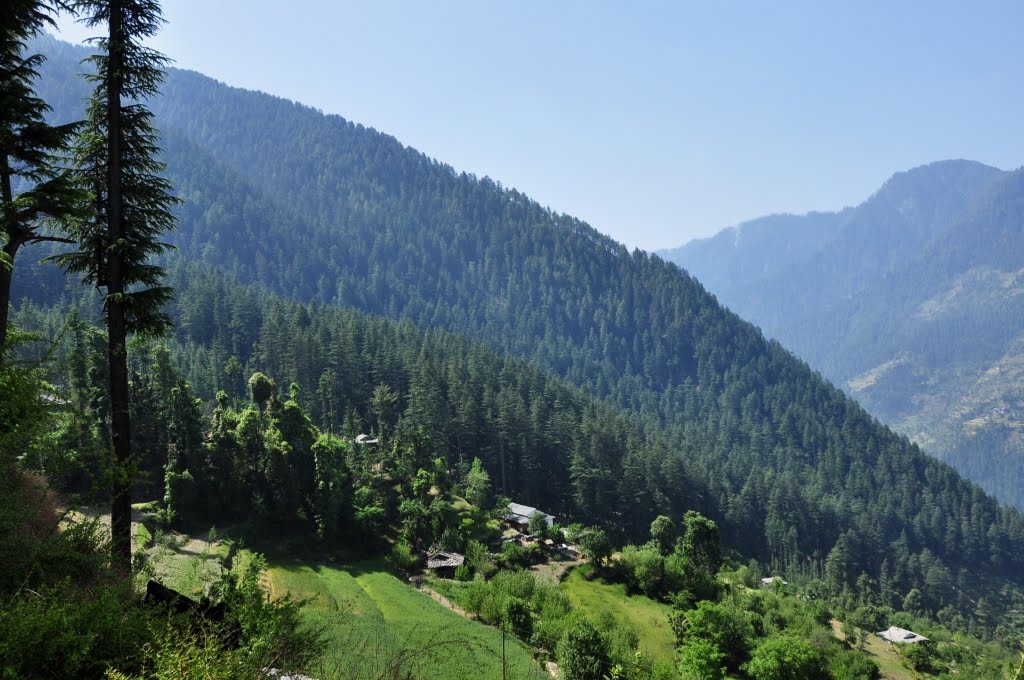
More importantly, this blog is an ode to my love for Shimla. I hope to show you this little town through my eyes. If you don't see too many people in it, forgive me, because I'm a little chary of turning this into a human zoo.

Stop by for a spell, look at my pictures, ask me questions about Shimla, if you wish. I shall try and answer them as best as I can. Let's be friends for a while....

31 July 2010

Prayer is the world in tune, A spirit-voice, and vocal joys, whose echo is Heaven's bliss.

Of all duties, prayer certainly is the sweetest and most easy. A prayer sent from the heart's deep core is a sally of the soul into the unfound infinite. Prayer may be inaudible speech, bit it is necessarily a candid dialogue with that higher entity, it is an attempt to represent yourself, in order to go to the roots of action.

I love to give thanks in solitude. For me, it is wordless, and mainly takes the form of thanksgiving. Thanksgiving gives my prayer wings and it goes where it must go. My prayer knows much more about it than I do. I say my prayer without giving the Almighty reasons why he should grant this, or that; he knows best what is good for us.

Prayer is not necessarily sitting before an idol, or telling beads, or reciting shlokas... To pray is to pay attention to something or someone other than myself. Whenever I concentrate my attention something so that I completely forget my own ego and desires, I am praying.


Prayer

Great God, I ask for no meaner pelf
Than that I may not disappoint myself,
That in my action I may soar as high
As I can now discern with this clear eye.
And next in value, which thy kindness lends,
That I may greatly disappoint my friends,
Howe'er they think or hope that it may be,
They may not dream how thou'st distinguished me.

That my weak hand may equal my firm faith
And my life practice what my tongue saith
That my low conduct may not show
Nor my relenting lines

That I thy purpose did not know
Or overrated thy designs.

Henry David Thoreau


30 July 2010

Hope likes justification, but can do without.

Ideas have been Gods for me. My consciousness a harmony of devotion to sanguine expectation. Hope, to me, has been that liar whose veracity I have never doubted even when belied. There have been times that I have despaired and, as the Bard says, "been at enmity with cozening hope". But such times have been few and far between, for I have found truth in what George Eliot says: "What we call our despiar in only the painful eagerness of unfed hope". The trick, I have found, is to confront suffering with hope. Hope triumphs every single time!
Hope has sometimes been fragile, and trembled like a harebell. Other times, it has been as solid as a rock and been my bulwark when all around me failure raged like a sea in storm. I have, however, refused to abandon what my friend HS calls my "pathological" belief in the occurrence of the impossible!
Here are some things which give me hope:


My faith, which is my anchor, my guide and the lantern which lights dark paths.


Children. Because they have two things in abundance: joy and a sense of wonder.


Dewdrops, which stand for all that is fragile and fast-disappearing and yet so essential in life.


Song of Hope

O sweet To-morrow! -

After to-day
There will away
This sense of sorrow.
Then let us borrow
Hope, for a gleaming
Soon will be streaming,
Dimmed by no gray -
No gray!

While the winds wing us
Sighs from The Gone,
Nearer to dawn
Minute-beats bring us;
When there will sing us
Larks of a glory
Waiting our story
Further anon -
Anon!

Doff the black token,
Don the red shoon,
Right and retune
Viol-strings broken;
Null the words spoken
In speeches of rueing,
The night cloud is hueing,
To-morrow shines soon -
Shines soon!

~ Thomas Hardy ~

29 July 2010

Thousand feet of sparkling water -- the Milky Way pouring down from heaven.


THE SEEKING OF THE WATERFALL
They left their home of summer ease
Beneath the lowland's sheltering trees,
To seek, by ways unknown to all,
The promise of the waterfall.

Some vague, faint rumor to the vale
Had crept--perchance a hunter's tale--
Of its wild mirth of waters lost
On the dark woods through which it tossed.

Somewhere it laughed and sang; somewhere
Whirled in mad dance its misty hair;
But who had raised its veil, or seen
The rainbow skirts of that Undine?

They sought it where the mountain brook
Its swift way to the valley took;
Along the rugged slope they climb,
Their guide a thread of sound and foam.

Height after height they slowly won;
The fiery javelins of the sun
Smote the bare ledge; the tangled shade
With rock and vine their steps delayed.

But, through leaf-openings, now and then
They saw the cheerful homes of men,
And the great mountains with their wall
Of misty purple girdling all.

The leaves through which the glad winds blew
Shared. the wild dance the waters knew;
And where the shadows deepest fell
The wood-thrush rang his silver bell.

Fringing the stream, at every turn
Swung low the waving fronds of fern;
From stony cleft and mossy sod
Pale asters sprang, and golden-rod.

And still the water sang the sweet,
Glad song that stirred its gliding feet,
And found in rock and root the keys
Of its beguiling melodies.

Beyond, above, its signals flew
Of tossing foam the birch-trees through;
Now seen, now lost, but baffling still
The weary seekers' slackening will.

Each called to each: 'Lo here! Lo there!
Its white scarf flutters in the air!'
They climbed anew; the vision fled,
To beckon higher overhead.

So toiled they up the mountain-slope
With faint and ever fainter hope;
With faint and fainter voice the brook
Still bade them listen, pause, and look.

Meanwhile below the day was done;
Above the tall peaks saw the sun
Sink, beam-shorn, to its misty set
Behind the hills of violet.

'Here ends our quest!' the seekers cried,
'The brook and rumor both have lied!
The phantom of a waterfall
Has led us at its beck and call.'

But one, with years grown wiser, said
'So, always baffled, not misled,
We follow where before us runs
The vision of the shining ones.

'Not where they seem their signals fly,
Their voices while we listen die;
We cannot keep, however fleet,
The quick time of their winged feet.

'From youth to age unresting stray
These kindly mockers in our way;
Yet lead they not, the baffling elves,
To something better than themselves?

'Here, though unreached the goal we sought,
Its own reward our toil has brought:
The winding water's sounding rush,
The long note of the hermit thrush,

'The turquoise lakes, the glimpse of pond
And river track, and, vast, beyond
Broad meadows belted round with pines,
The grand uplift of mountain lines!

'What matter though we seek with pain
The garden of the gods in vain,
If lured thereby we climb to greet
Some wayside blossom Eden-sweet?

'To seek is better than to gain,
The fond hope dies as we attain;
Life's fairest things are those which seem,
The best is that of which we dream.

'Then let us trust our waterfall
Still flashes down its rocky wall,
With rainbow crescent curved across
Its sunlit spray from moss to moss.

'And we, forgetful of our pain,
In thought shall seek it oft again;
Shall see this aster-blossomed sod,
This sunshine of the golden-rod,

'And haply gain, through parting boughs,
Grand glimpses of great mountain brows
Cloud-turbaned, and the sharp steel sheen
Of lakes deep set in valleys green.

'So failure wins; the consequence
Of loss becomes its recompense;
And evermore the end shall tell
The unreached ideal guided well.

'Our sweet illusions only die
Fulfilling love's sure prophecy;
And every wish for better things
An undreamed beauty nearer brings.

'For fate is servitor of love;
Desire and hope and longing prove
The secret of immortal youth,
And Nature cheats us into truth.

'O kind allurers, wisely sent,
Beguiling with benign intent,
Still move us, through divine unrest,
To seek the loveliest and the best!

'Go with us when our souls go free,
And, in the clear, white light to be,
Add unto Heaven's beatitude
The old delight of seeking good!'

~ John Greenleaf Whittier ~


28 June 2010

The very form, the very scent, not heavy, not sensuous, but perilous perilous of orchids


I've been meaning to make a post on orchids for a while now. Say the word and you get a range of intriguing reactions from people. It goes from outright delight and wonderment to sheer aversion. William Faulkner goes so far as to say "Nasty things. Their flesh is too much like the flesh of men, their perfume has the rotten sweetness of corruption."


Personally, I am enamoured by their complexity and diversity and above all, their cosmopolitanism! They appear in almost every sort of habitat you can think of. Excepting glaciers and deserts, of course. The largest number of species occurs in the tropics, but is followed closely by countries in the temperate region. Very few orchid-lovers know the startling fact that the number of orchid species is almost twice that of bird species and almost four times the mammal species.


In my hunt for orchids to photograph, I found interesting variation, which I'm going to illustrate in my deeply unscientific fashion. I found two whorls: an outer one with three sepals and an inner one with three petals. The upper medial petal appeared to be much more enlarged and modified, perhaps to aid pollination. There are three stamens whose filaments appeared fused or joined to my untrained eye.


Reading up about orchids, I cam across some interesting facts. Like the one that everyone's favourite flavour, vanilla, is an orchid genus. Or that orchids are used for making hot beverages, for flavouring ice cream and even rum! In Turkey, certain species of orchids are considered to have aphrodisiac powers.


Here in Shimla, I've found the prettiest orchids being grown by Shri Mela Ram Sharma for the Indian Institute of Advanced Study. My friend R's venerable father-in-law also grows gorgeous ones. Orchids which he's brought from Sikkim and Meghalaya and which, miraculously, survive the heat and humidity of Sunni.

For the detail-minded reader, some limited information:
Kingdom: Plantae
Order: Asparagales
Family: Orchidacaea


16 June 2010

Sacrifice is nothing other than the production of sacred things


My journey to Ani had been uneventful, bordering on the boring. For one thing, a road-block at Theog had forced me to back-track up to Basantpur and make a detour via Luhri which was hot, hot, hot. Ani itself was unspectacular, constructed along the highway, all it had to show for itself was a row of really unattractive shops. I couldn’t wait to move on to Khanag where the memorial plaque for Penelope Chetwode (I’ve written about this earlier) waited to be explored.

At the guesthouse, I bumped into some men who work for the Public Works Department. Anything interesting to be seen in these parts, I asked them. Well, there’s a little temple at Shamshar. Nothing great, you see. But it’s not bad. Considering that I’d been starved for any sort of cultural relief, I grabbed at this opportunity. The men were headed the same way and agreed to go with me to show me the temple.

I won’t go into a detailed description of the temple as is my wont. It was a typical Himachali temple: chalet and spaceship rolled into one, quaintly attractive, unobtrusive and tremendously colourful. There were two taller structures behind it. One squat, painted white and embellished with the most attractive wood carvings you ever saw. The second was built in the typical “dehra” style. A tall building topped off by a pagoda-style roof, painted in candy shades. This temple was draped with a huge rope whose diameter was thicker than my wrist. Idly, I asked one of the PWD men if Himachal had a tradition of people physically pulling the Gods’ chariots with these ropes. Oh, no, no, he said. And thereby hung a tale. I am going to recount it almost as he told me.

It is said that on the orders of his father Jamadagni, Parshurama had killed his mother Renuka. When asked what boon e would like for this act of extreme obedience, Parshurama begged his father to bring his mother back to life. However, he needed to expiate the sin of matricide, so he donated land to the Brahmins of Nirmand and deemed that a “yajna” every three years and “bhunda” (human sacrifice) every twelve years.

The person who offers himself as sacrificial victim is called “beda” and comes from a community of people which has, for generations, offered one of its members for this purpose. He is required to plait a rope over 500 metres long. This rope will play a very important role in the “bhunda” ceremony. During the fifteen days preceding the “bhunda” ceremony, the “beda” is fed and clothes at the expense of the temple and is associated closely with the goddess as he is no longer seen as one of the human race.

The rope the victim has plaited will be slung out over a cliff and the “victim” will have to slide down this rope. Should he be fortunate enough to survive this slide, his life is spared, but in the old times, death must have been a certainty. Hundreds of devout volunteers carry the rope which has been carefully plaited by the “beda” to the site where the “sliding ceremony” will take place. Meanhile, the “beda” is taken to the temple and formally dedicated to the goddess Ambika. Draped in a shroud, he is carried to the sacrificial site by other devotees. Weighed down by sacks filled with grain and/or sand, he is made to walk on the rope.

As I’ve said above, death is a certainty, but there is insurance for his widow. When the “beda” is dead, his widow is allowed to select any of the items she sets her sights on. Whatever she touches is hers that day. In this way, tradition ensures that she is not left destitute by the demise of her husband.

So important is this ceremony that Gods of neighbouring areas specially visit Shamshar in full ceremonial regalia. They are taken out in a procession their path lit by huge flaming torches. An interesting aside to this event is that a sacred water vessel belonging to Parshurama is brought out especially for this occasion. Water in this vessel is replenished by a sacred spring in the village. Legend has it that the spring appears only the year “bhunda” is held. It remains dry, indeed, invisible for the entire period when Parshurama is in retreat.

Once the ceremony is over, all ritual articles and the image of Parshurama are taken back to the shrine. The visitng Gods depart for their homes, taking with them the masses of curious, innocent villagers who had come to witness this unique ceremony; the massive doors are bolted, not to be opened for a further twelve years.


The memorial majesty of Time, Impersonated in thy calm decay

I was travelling from Sojha to Banjar, when like my more famous travel predecessor, Maharaja Bhupinder Singh of Patiala, I decided to stop off at Bagi to check out the Shringi Rishi temple. I have repeated ad nauseum my dislike for the blatant and impious skullduggery that is Indian's temples. Shringi Rishi proved no different. Also, unlike Himachal's temples, the keepers of this one allow devotees to climb right into the sanctum sanctorum. What results is a lot of noise and typical filth carried in my human feet, and an all-pervading wretched fragrance which is a mix of human perspiration, cheap incense and decaying flowers.


Exeunt temple. It must have been an attractive one before it went commercial with a vengeance. Sitting outside was an old couple who watched my entry and speedy exit. Would you like to see a far more beautiful jewel, they asked. Of course I would, I replied, somewhat indignant that this pair of strangers should doubt the extent of my curiosity. Right then, you see that trail going up? Just follow it and you will see one of the most beautiful forts in all Himachal.
I am glad I listened to them, or I would have missed this nonpareil, this pearl of a ziggurat!


Chaihni is what Wordsworth would be delighted to call "a hoary pile". Not visible from the main road, this gorgeous castle is a couple of kilometres of walking at an almost 40-degree angle. The walk is breath-taking, and I do not say this with irony. For most part, you have a 360-degree view of dense evergreen forests and a patchwork of step-cultivated farms. Here and there, you come upon picturesque little barns with piles of golden, sweet-smelling hay, here an abandoned loom, there a curving path. This is a tranquil land, beneath a sky of bliss.


It s not as though there is no toil or strife. But on the whole, a silence pervades. You feel that Nature breathes ease into the lives of those who live here in Chaihni, high up, in steadfast peace.
As you walk up, you are forced to tilt your head to look up at this gorgeous castle, standing there in all its sublime beauty, a picture of fortitude in the face of the ravages Time wreaks on men and material alike.


The fort is 125 feet tall. An architectural marvel of unknown age. Is it a temple, a watch-tower, or a citadel, it is hard to tell. Like forts and castles all over Himachal, in a sense, it is all three. It displays all the attractive features of timber-bonded stone topped off by a chalet-style wooden roof. A little ladder clings precipitously to one wall, the only tiny symbol of a pageantry this imposing hulk seeks to impose on its viewer.
As I've mentioned before, it is not possible for anyone to enter such an edifice, doubling up as it does for a citadel, temple, and village treasury. As luck would have it, I had met the priest or caretaker of the Chaihni fort on my walk up to the village. This kindly old man had, in the span of the thirty minutes it took for me to huff and puff up the hill, developed an amused interest in my antics. It was only logical, he said, that if the Gods had willed me to come thus far, that I should be allowed in the celestial presence. So off we went, up into the fort. The sight was magical and to this day, I do not know if I was giddy from the height or the idea that I was being allowed into the sacred space. But the way that roof rises to the sky in fatastic pride makes blood rush to the head...


The sight was a fascinating one. Gods piled upon Gods. Polished to a burnished gold. Decorated with flowers and Chinese-made baubles and doodads. Up here, the divinities appear content and amenable to being propitiated. The priest asks me if there's anything I want. And foolishly, like a beauty contest participant, I blurt out: world peace!


Go see Chaihni if you are travelling in the southern parts of Kullu. It will surpise and please you yet.

10 June 2010

Thou blushest from the painter's page, Robed in the mimic tints of art...


Still, still my eye will gaze long fixed on thee,
Till I forget that I am called a man,
And at thy side fast-rooted seem to be,
And the breeze comes my cheek with thine to fan,
Upon this craggy hill our life shall pass,
A life of summer days and summer joys,
Nodding our honey-bells mild pliant grass,
In which the bee half hid his time employs,
And here we'll drink with thirsty pores the rain,
And turn, dew-sprinkled, to the sun,
And look when in the flaming west again,
His orb across the heaven its path has run;
Here left in the darkness on the rocky steep,
My weary eyes shall close like folding flowers in sleep.
~ Jones Very ~


I spotted Columbines in the woods of Sheogh in June last year, thanks to Dr. Suresh Nair. This year, they were closer at hand in Sanjiv's lovely garden. In Sheogh, I found it growing in partial shade, whereas at Sanjiv's place, it grows in full sunlight. Its height in both places was about 15 to 20 inches. Sanjiv says the plant is partial to a well-drained soil, but is hardy enough not to require mulching or protection in the winter. She informs that she propagates it by seed.
Elegantly formed and coloured in shades of lilac, violet and white, this flower is very easy to distinguish because of its five backward projecting spurs of the inner petals. A row of inner and outer petals form the columbine, which grows at a 90-degree angle to its stem. The leaves appeared similar to ferns to my untrained eye.
The botanical name of the columbine Aquilegia comes from the Latin word aquila, an eagle, perhaps, in reference to the claw-like spurs which grow at the back of the flower. The name columbine comes from columba, a dove.

Scientific details:
Kingdom: Plantae
Division: Magnoliophyta
Class: Magnoliospida
Order: Ranunculales
Family: Ranunculaceae
Genus: Aquilegia


16 May 2010

The love-gift of a fairy-tale

I love fairy tales not because the imagery I find in them conforms to what goes on within me. Also because— although a fairy tale gave body and content to all the angry, anxious thoughts in my mind — these stories always result in a happy outcome. What better than to wander discouraged and confused as Hansel and Gretel through a dark wood of witches! To strike the hot right way suddenly, but just as suddenly to mire, to drag, to speed, to shout Hurray! To fall asleep, to submit to revelations, certainly to curl a lip, to doubt, unnose a disdainful snort, snick a superior snicker, curse, and then at some point not very pleasantly to realize that the story I am living is the story of life itself!!!

Therefore, on one of my rambles, I got unnecessarily excited to stumble upon a gingerbread house. To look at it made me feel like I was 10 again. I looked at it with trepidation and a thumping heart. To walk up to it, to knock on its door, and perchance to have the Wicked Witch open the door... But no such thing happened. For one thing, I got lost in the woods, and had to make my hasty way out before dark fell. For another, when I did reach the house, it was opened by an unbearably sweet young lady who looked more like Gretel than the Witch.

Ah well... sometimes it is better let a fable stay in your head.

Here's the fairy tale:

Hansel and Gretel are the young children of a poor woodcutter. They have an evil step-mother who convinces the father to abandon the children in the woods as there is not enough food to feed the whole family. Hansel, aware of the plan, leaves a trail of pebbles back to the house so he and his sister find their way back home. The step-mother is angry and locks the two children up for the night with only a loaf of bread and water.

The next night, the woodcutter attempts the same plan again; this time Hansel leaves a trail of bread-crumbs but they get eaten by hungry birds and the two children get lost in the woods.

After wandering around, Hansel and Gretel stumble across a house made of gingerbread and other confectionery. They are very hungry and begin to eat it. It is owned by an evil old witch who lures them inside. She traps Hansel in a cage and forces Gretel to do the housework, continually sweeping the house. She feeds Hansel lots of food with the intention of eating him. Eventually the witch turns on the oven. Gretel comes up behind her and kicks her into it, shuts the door firmly and padlocks it.

They hang around in the house for a couple of days eating the sweets and they find some valuable gold coins. Once they are convinced that the witch is completely burnt they successfully find their way home and are met by their ecstatic father. He tells them that his evil wife is dead and they are now rich because of the gold coins' value.

They all live happily ever after.


13 May 2010

An uncertain heaven, received into the bosom of the steady lake


Little puffy clouds dotted the sky. I had a glorious wild view of the little lake called Tanu-Jubbar which was no larger than a big pond. All around was a damp and intricate wilderness. Boundless forest undulated away from its shores on all sides, densely packed, and enveloping nameless mountains in its succession. It was a perfect lake of the woods.


The morning was a bright one, and perfectly still and serene, the lake as smooth as glass, no ripples marking its surface. The surface crinkled a little when the wind gently blew over it. The dark mountains about it were seen through a glaucous haze. The wood thrush sang as if inspired by the morning, his song came distinct over the lake to me... What was more remarkable, the echo which ran round the lake was much louder than the original note; the sound being reflected like light from a concave mirror.

Tanu-Jubbar is the landscape's most beautiful and expressive feature. It is earth's eye; looking into which the beholder measures the depth of his own nature. The trees growing on its shore are the slender eyelashes which fringe it, and the wooded hills and cliffs around are its overhanging brows.

A little temple sits at the edge, much like a friend who decides to give you company because they sense in your countenance a contemplation that needs no words, nor any validation.


[Note for the detail-minded among my gentle readers: Tanu-Jubbad is best accessed from NarkandaJustify Full. It lies a mere 10 kilometres from Narkanda if you travel on the highway which goes past the path leading up to Hatu Peak. A little further on it there is a fork in the road, one leads towards Baghi and Sungri and the smaller one towards Nankhari and eventually, Tanu-Jubbad. There are no eateries, stalls of any sort close by, so if you plan to picnic by the lake-side, please carry your own food and water. The usual injunctions of leaving behind only footprints and taking away only memories apply!]

10 May 2010

High on a hill was a lonely goatherd...

High on a hill was a lonely goatherd
Lay ee odl lay ee odl lay hee hoo
Loud was the voice of the lonely goatherd
Lay ee odl lay ee odl-oo

Folks in a town that was quite remote heard
Lay ee odl lay ee odl lay hee hoo
Lusty and clear from the goatherd's throat heard
Lay ee odl lay ee odl-oo


O ho lay dee odl lee o, o ho lay dee odl ay
O ho lay dee odl lee o, lay dee odl lee o lay

A prince on the bridge of a castle moat heard
Lay ee odl lay ee odl lay hee hoo
Men on a road with a load to tote heard
Lay ee odl lay ee odl-oo

Men in the midst of a table d'hote heard
Lay ee odl lay ee odl lay hee hoo
Men drinking beer with the foam afloat heard
Lay ee odl lay ee odl-oo


One little girl in a pale pink coat heard
Lay ee odl lay ee odl lay hee hoo
She yodeled back to the lonely goatherd
Lay ee odl lay ee odl-oo

Soon her Mama with a gleaming gloat heard
Lay ee odl lay ee odl lay hee hoo
What a duet for a girl and goatherd

Lay ee odl lay ee odl-oo


Ummm (ummm)...
Odl lay ee (odl lay ee)
Odl lay hee hee (odl lay hee hee)
Odl lay ee ...


One little girl in a pale pink coat heard
Lay ee odl lay ee odl lay hoo hoo
She yodeled back to the lonely goatherd
Lay ee odl lay ee odl-oo

Soon her Mama with a gleaming gloat heard
Lay ee odl lay ee odl lay hmm hmm
What a duet for a girl and goatherd
Lay ee odl lay ee odl-oo

Happy are they lay dee olay dee lee o ...
Soon the duet will become a trio
Lay ee odl lay ee odl-oo

Odl lay ee, old lay ee
Odl lay hee hee, odl lay ee
Odl lay odl lay, odl lay odl lee, odl lay odl lee
Odl lay odl lay odl lay


Related Posts with Thumbnails