Why this blog is called "Gallimaufry".

gal-uh-MAW-free\, noun.

Originally meaning "a hash of various kinds of meats," "gallimaufry" comes from French galimafrée; in Old French, from the word galer, "to rejoice, to make merry"; in old English: gala + mafrer: "to eat much," and from Medieval Dutch maffelen: "to open one's mouth wide."

It's also a dish made by hashing up odds and ends of food; a heterogeneous mixture; a hodge-podge; a ragout; a confused jumble; a ridiculous medley; a promiscuous (!) assemblage of persons.

Those of you who know me, will, I’m sure, understand how well some of these phrases (barring the "promiscuous" bit!) fit me.

More importantly, this blog is an ode to my love for Shimla. I hope to show you this little town through my eyes. If you don't see too many people in it, forgive me, because I'm a little chary of turning this into a human zoo.

Stop by for a spell, look at my pictures, ask me questions about Shimla, if you wish. I shall try and answer them as best as I can. Let's be friends for a while....

Showing posts with label Himachal's forts and castles. Show all posts

14 September 2010

The powerful, fortress'd house...

Gondhla is a pretty little, topsy-turvy village located on the banks of the River Chandra. About 18 kilometres along the way from Keylong to Manali, crane your neck out from the window of your bus or car, and you will spot this gorgeous fort considerably off the right side of the road.


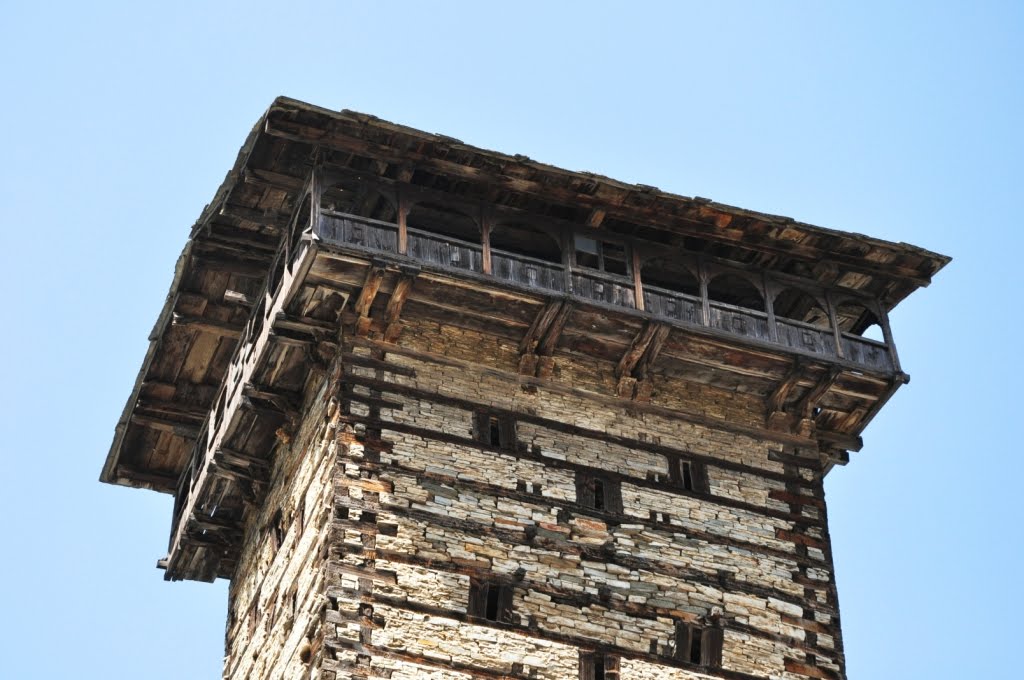
A rugged pile, you notice the timber-bonded pattern which is typical of Himachal's forts and castles. Penelope Chetwode observed that this structure was common to both sacred as well as secular buildings. Stone and timber alternate in layers in these walls and are held together by clay. Experts say that it is this style which protected the tall edifices from seismic shocks. Apparently, the absence of mortar between the dressed stone, according to Chetwode, allowed the walls the chance to quiver with the quake instead of opposing the earthquake's movements. What a simple, yet ingenuous solution!


Displaying another typical feature of Himachali forts, a wooden gallery runs around the top floor. I am guessing that this would have served the local ruler to conduct public audience, though what he would have actually heard of his people's grievances is anybody's guess! Certainly, the height of this lovely old building inspires a sense of awe. The very act of craning one's neck upwards makes one aware of one's small size in relation to the fortress.
There are wonderful little windows with intricate bars across them. Great for looking out, but impossible to look into. I am sure they would have served the women who lived there well, considering how little airing women of royal families got in those days! The wooden frames of the windows are delicately carved with geometric and floral motifs.


The related page of the Lahaul & Spiti District Administration describes the interiors and its wonderful contents. But the sad fact is that in the middle of 2010, my friend SdS and I found rubble all around the fort, the main door locked with masonry fallen over it. Bits of the little "kharokhas" - the little wooden balconies projecting out of the windows - have crumbled, the wood eaten away by termites and by the ravages of weather. Parts of the roof and the top room are also falling away. It is tragic that this wonderful heritage of our state crumbles away before our eyes and all we can do is mourn its passing.
Through this blog, I appeal to anyone who is reading to suggest a way. If nothing, maybe we should petition the Government to protect this building which is, by sarkari accounts, over four hundred years old.


14 August 2010

That foolish fort, a heart...

Some of the best things in life happen unexpectedly. SdS and I had wandered up into the polychromatic gompa at Ghemur. It was one of those days you just know will be magical. You just don't know how... The sun had been playing hide and seek and shadows of the clouds overhead dappled the mountainsides. The monastery was closed and all the Lamas had left for Khardang where they were celebrating special prayers.
But an unpredicted bonus awaited us in the form of a little old man. We met Nyema Dhondup. By having wandered around the gompa open-mouthed and ooh-ed and aah-ed over an amazing collection of carvings on stone which represented various incarnations of Buddha, somehow, SdS and I had managed to unbend the old gentleman. "Would you like to see a fort?", he asked. Being old hands at fort-spotting, yes, yes, we almost babbled in excitement. Follow me, he said.
So up, up, up we went. This was a narrow overgrown path, leading up from Ghemur. Thick bushes of primroses, harebells and buttercups leaned onto it. We were out of breath in no time at all. But could not decide: was it the steep climb? The sheer variety, colour and fragrance of the wild flowers? Or the stunning vistas all around? It was hard not to fall to one's knees and thank the Almighty for letting us be here.
We followed a village trail. Women were bent over, harvesting peas. A man lazily chewed a stick of grass. A big brown cow looked up inquiringly from its grazing. The narrow mountain path had abruptly widened into a valley, sometimes skirting the river Chandra, other times going farther afield from it.


There, rising towards the mountains, with lines as straight and precise as to gladden an engineer's heart, lay the stupendous fort of Khangsar. The shape of fort makes an enchanting vision: its glacis into the river below counterpoised by its linearity. The solitude of the scenery was unbroken, except for a tier of house here and a chain of chortens there.


Made of mud and wood, its walls smoothened by age, it sat in the midst of the little village like an old soldier, tired and resting after a long war. The thing I love most about old structures, particularly those made natural materials is their colours: chestnut, terracotta, auburn, sorrel, ochre, puce, ginger, burnt sienna... they are a delight of browns!


The inside of the fort is every bit as awe-inspiring as the ramparts viewed externally. It is hard to tell from outside that this little building contains one hundred and eight rooms. Interestingly, all rooms are built around a sort of atrium. However, unlike the classical atrium design, the roof does not open into the sky, or is covered with glass. It is just a normal roof, covered with mud and thatch and wood. There were, however, a number of small windows which let in a sufficient quantity of light.
To me, the most interesting aspect of the fort were the little well-like structures in each room. You will notice one in the photograph above. It is a small square arrangement with wooden slats all around, perhaps to prevent the curious from falling in! The interesting thing is that looking down you find yourself staring into a giant kitchen. In the old days, big fires were lit in the cooking area. These were used not only for cooking, but also for heating water. More importantly, following the well known theory of physics, the warm air rose and managed to warm the entire castle. What an ingenuous system!


Ask me about the one feature that struck me about the Khangsar fort, and I will say it was the carving on the wood. The patterns were incredibly delicate, so finely-wrought in their detail. It is like seeing lace on wood. The motifs, interestingly, find resonance in many gompas around Lahaul. The dragons, the inverted flower buds, the lotuses, the waves and the pearls in flames. You also notice the typical and incredibly lovely chequered pattern hewed out of the wood and then embellished in bright cobalt blues and forest greens.


Entering the sanctum sanctorum of the fort, one finds the usual spot designated for the deities of the family. Now here is an intriguing aspect. An ageing sepia photograph reveals the Rana to be a gentleman of distinctively Indian features. He looks as though he could belong to anywhere in Himachal and is probably a Hindu. His face is unlike the people he would have ruled, whose features are Monogoloid.
Juxtaposed with this is the fact that the area of worship is completely Buddhist - whether it is the religious texts, swaddled in colourful silk, the deities, mainly Avalokiteswara and Padmasambhava, and all other accoutrements of devotion: the offering bowls, the butter lamps, the prayer wheels, the drilbu (the bell, rung during prayer), the kapala (in this case the skull was that of a goat!) and the dorje, the small sceptre which represents Buddha's compassion.

The little fort, standing up valiantly against the rampage of weather and time, betokens an age of grace, of tolerance and a culture that was urbane while existing happily in the midst of wilderness. The deliciously straight lines, the sumptuous colours, the projecting terraces topped with a pillar in turn embellished with rams' horns. One never gets tired of uttering exclamations of joy!


16 June 2010

The memorial majesty of Time, Impersonated in thy calm decay

I was travelling from Sojha to Banjar, when like my more famous travel predecessor, Maharaja Bhupinder Singh of Patiala, I decided to stop off at Bagi to check out the Shringi Rishi temple. I have repeated ad nauseum my dislike for the blatant and impious skullduggery that is Indian's temples. Shringi Rishi proved no different. Also, unlike Himachal's temples, the keepers of this one allow devotees to climb right into the sanctum sanctorum. What results is a lot of noise and typical filth carried in my human feet, and an all-pervading wretched fragrance which is a mix of human perspiration, cheap incense and decaying flowers.


Exeunt temple. It must have been an attractive one before it went commercial with a vengeance. Sitting outside was an old couple who watched my entry and speedy exit. Would you like to see a far more beautiful jewel, they asked. Of course I would, I replied, somewhat indignant that this pair of strangers should doubt the extent of my curiosity. Right then, you see that trail going up? Just follow it and you will see one of the most beautiful forts in all Himachal.
I am glad I listened to them, or I would have missed this nonpareil, this pearl of a ziggurat!


Chaihni is what Wordsworth would be delighted to call "a hoary pile". Not visible from the main road, this gorgeous castle is a couple of kilometres of walking at an almost 40-degree angle. The walk is breath-taking, and I do not say this with irony. For most part, you have a 360-degree view of dense evergreen forests and a patchwork of step-cultivated farms. Here and there, you come upon picturesque little barns with piles of golden, sweet-smelling hay, here an abandoned loom, there a curving path. This is a tranquil land, beneath a sky of bliss.


It s not as though there is no toil or strife. But on the whole, a silence pervades. You feel that Nature breathes ease into the lives of those who live here in Chaihni, high up, in steadfast peace.
As you walk up, you are forced to tilt your head to look up at this gorgeous castle, standing there in all its sublime beauty, a picture of fortitude in the face of the ravages Time wreaks on men and material alike.


The fort is 125 feet tall. An architectural marvel of unknown age. Is it a temple, a watch-tower, or a citadel, it is hard to tell. Like forts and castles all over Himachal, in a sense, it is all three. It displays all the attractive features of timber-bonded stone topped off by a chalet-style wooden roof. A little ladder clings precipitously to one wall, the only tiny symbol of a pageantry this imposing hulk seeks to impose on its viewer.
As I've mentioned before, it is not possible for anyone to enter such an edifice, doubling up as it does for a citadel, temple, and village treasury. As luck would have it, I had met the priest or caretaker of the Chaihni fort on my walk up to the village. This kindly old man had, in the span of the thirty minutes it took for me to huff and puff up the hill, developed an amused interest in my antics. It was only logical, he said, that if the Gods had willed me to come thus far, that I should be allowed in the celestial presence. So off we went, up into the fort. The sight was magical and to this day, I do not know if I was giddy from the height or the idea that I was being allowed into the sacred space. But the way that roof rises to the sky in fatastic pride makes blood rush to the head...


The sight was a fascinating one. Gods piled upon Gods. Polished to a burnished gold. Decorated with flowers and Chinese-made baubles and doodads. Up here, the divinities appear content and amenable to being propitiated. The priest asks me if there's anything I want. And foolishly, like a beauty contest participant, I blurt out: world peace!


Go see Chaihni if you are travelling in the southern parts of Kullu. It will surpise and please you yet.

9 March 2010

Let me be at the place of the castle. Let the castle be within me.

The wings of fancy are powerful. They can bear you up to mid-air, and allow you to construct a stupendous castle there. But it is so much the better to chance upon one, a real one, perched as if in mid-air, when you are looking for something else!


Last week, I went looking for the stone-cut temples at Balag (this is in Shimla's Theogh sub-division) and en route espied a gorgeous building, what Wordsworth would call a "rugged pile" at Sainj. It stood there with a handsome, stony face, a strong, weather-beaten sentinel sunning itself in the pure and sweet air.
As the Brad notes in Macbeth:
This castle hath a pleasant seat; the air
Nimbly and sweetly recommends itself
Unto our gentle senses.


This building, which reminded me of a mighty, yet gentle giant had a sleepy air inside. Little beams of sunshine peeped through beautiful trellis-work, making pretty patterns on the walls. A calm prevailed, the air resigned to the dust of history and achievements past. Here and there, a gleam consecrated the overall gloom.


The place, or castle, or what you will is built on tranquil land. The stone and wood are strong, yet speak not so much for fire-eating dragons or cruel princes sweeping in horses with frothing mouths. Rather, the place seems to smile, if a little wistfully, as it bathes in the sunshine of bliss.


There is nothing quite as romantic as a castle-palace-fortress. Nothing quite as delicious as its slightly decrepit air, the all-embracing sweep of the mountains, the groves of fruit, the fields and farms, the enchanting climate!


This castle looks as though it is a treasure-house of memories of peaceful years, a chronicle of happier times, of lasting ease and of an almost Elysian quiet. Yet, underneath this steadfast peace, also lies a sea of physical distress, caused by age and impecunious times. Old wood stands there sublime, encasing the castle from the unfeeling armour of time, fierce winds, trampling storms, heartless sunshine. Chocolate, cinnamon, beige, auburn and sorrel streak the walls. The colours speak of welcome fortitude and patient cheer, commodities we of the modern times and urban lives would do well to learn.


[A note on the commonplace: Sainj is best approached from Shimla via Theogh. The total distance is about 40 kms. This Sainj is not to be confused with the one in Kullu district. The Ranas are remarkably easy-going people, which is why you would be disinclined to impose on their kind hospitality and their generosity in opening up their home to complete strangers. ]

8 October 2009

A towered citadel, a pendant rock, a forked mountain...


Travel into the heart of Kinnaur and it is inevitable that you find yourself at Sangla, an edgy little town ranged along the Baspa. The settlement has little to recommend for itself, except a sort of ubiquitous Kinnauri prettiness and a huge mountain which, my local companion explains is "the back-side of the Kinner Kailash", that last being one of the tallest peaks in these parts.


The greatest find in Sangla is the lovely old fort of Kamru. Locals are incertain of its provenance, claiming it to be anything between four to seven hundred years old. It is a structure found commonly in Himachal. A tall wooden building, several stories high, so located as to serve as both a fortification and a look-out point for the village.
The climb up from the village is a steep one,. If you find it difficult to breathe, blame it not just on the steep incline, or the low levels of oxygen in the mountain air, but on the views all around which take your breath away! Just look at this magnificent fortification. It is designed to inspire awe in the manner in which it forces the viewer to crane her neck and make her eye travel upwards!


At the entrance is an imposing gate. This is made of old wood, embellished with a gorgeous motifs made in beaten metal of some sort, probably copper. The vagaries of the sun, the snow and the wind have burnished the copper into most attractive shades of titian, russet and henna. The visitor must take his shoes off at the entrance and put on a Kinnauri cap and a sort of string-like belt as a mark of respect to the royalty and the presiding deity.
Tall visitors are warned: the door in the picture above is designed to make you lower your head as you enter! Also, the fort doors are open only for a fxed while in the morning. So, should you be interested in exploring the fort, make sure you present yourself at its portals no later than ten o'clock in the morning.


What you see above is the little structure through which the visitor emerges having passed through the imposing doorway of the Kamru citadel. Some interesting musical instruments hang from sundry nails on its walls, unintentionally creating a fabulous Manetesque, still-life like effect.


Directly to the left as you enter lies this tiny hut. Evidently, it is a storage space for the palanquin of the presiding deity. It is on this palanquin that the deity goes for an "airing". I do not mean this in levity. Through a medium, locally known as a "ghoor", the deity has been known to express a desire to go visitng her siblings and friends in neighbouring villages; thus occasioning much celebration and gaiety.


The deity of Kamru, Kali, is much feared locally. Several bloodthirsty fables are attributed to her. Most important of all is the local concept of "darohi" or treachery. Legend has it that the Raja who ruled from Kamru demanded vassalage from all the thakurs (headmen) of surrounding villages. One day, finding himself encircled by Tibetan, he sent out frantic messages requesting support from his vassals. However, he was betrayed by a thakur and a local tailor from the village of Chini who told the Tibetans a way by which the ramparts of the Kamru fort could be brought down.
The Tibetans, and indeed the traitors, had not reckoned with the powers of the deity which were ranged alongside Kamru's ruler. Those supernatural powers and the mundane reality of approaching winters, made the Tibetans abandon their plans and at length, the Raja was able to chase them out of the valley.
This episode, however, left a bad taste in the royal mouth. And so was born the concept of "darohi", or treachery. The recalcitrant thakur was reduced to vassalage and the tailor, poor man, lost his head!
The Raja then ordered that a representative of Chini village be present every year at the eight-day festival held in honour of his deity. The poor man is then plied freely with liquour until he's fairly senseless. He is then dressed up in a mock armour and made to perform a sort of burlesque before the assembly of Kamru's residents. The idea is to make the village of Chini a laughing stock and to parody the treacherous actions of the thakur and the tailor. Water is then sprinkled over the head of this representative in a symbolic representation of his "beheading".
To be sure, people from Chini told me that no one wants to participate in this mock ritual which keeps the memory of their traitorous ancestor alive. On their part, the Rajas who ruled Kamru (of the Rampur-Bushahr line) have eased things by allowing waterto be poured over the representative's hands, instead of his head!
The concept of "darohi", however, is alive and kicking. Acting like an oath of loyalty, today it ensures obedience of the rule of law.
Related Posts with Thumbnails