Why this blog is called "Gallimaufry".

gal-uh-MAW-free\, noun.

Originally meaning "a hash of various kinds of meats," "gallimaufry" comes from French galimafrée; in Old French, from the word galer, "to rejoice, to make merry"; in old English: gala + mafrer: "to eat much," and from Medieval Dutch maffelen: "to open one's mouth wide."

It's also a dish made by hashing up odds and ends of food; a heterogeneous mixture; a hodge-podge; a ragout; a confused jumble; a ridiculous medley; a promiscuous (!) assemblage of persons.

Those of you who know me, will, I’m sure, understand how well some of these phrases (barring the "promiscuous" bit!) fit me.

More importantly, this blog is an ode to my love for Shimla. I hope to show you this little town through my eyes. If you don't see too many people in it, forgive me, because I'm a little chary of turning this into a human zoo.

Stop by for a spell, look at my pictures, ask me questions about Shimla, if you wish. I shall try and answer them as best as I can. Let's be friends for a while....

Showing posts with label Kinnaur. Show all posts

11 December 2009

The rapt, imperious, sea-going river

I was reminded of these lines by Ramond Foss:

“And you give them drink from the
river of your delights.”

Cool clear untrammeled waters
An endless river of the wellspring of life

Hope in the wilderness
manna from heaven
and the light in the darkness

The path along the way
and our hope for eternity...


And this one by Ella Wheeler Wilcox:


I am a river flowing from God’s sea
Through devious ways. He mapped my course for me;
I cannot change it; mine alone the toil
To keep the waters free from grime and soil
The winding river ends where it began;
And when my life had compassed its brief span
I must return to that mysterious source.
So let me gather daily on my course
The perfume from the blossoms as I pass,
Balm from the pines, and healing from the grass,
And carry down my current as I go
Not common stones but precious gems to show;
And tears (the holy water from sad eyes)
Back to God’s sea, from which all rivers rise,
Let me convey, not blood from wounded hearts,
Nor poison which the upas-tree imparts.
When over flowery vales I leap with joy,
Let me not devastate them, nor destroy,
But rather leave them fairer to the sight;
Mine be the lot to comfort and delight.
And if down awful chasms I needs must leap,
Let me not murmur at my lot, but sweep
On bravely to the end without one fear,
Knowing that He who planned my ways stands near.
For Love is all, and over all. Amen.


21 November 2009

Impossible stone... crumpled water...


'Whenever I plunge my arm, like this,

In a basin of water, I never miss
The sweet sharp sense of a fugitive day
Fetched back from its thickening shroud of gray.
Hence the only prime
And real love-rhyme
That I know by heart,
And that leaves no smart,
Is the purl of a little valley fall
About three spans wide and two spans tall
Over a table of solid rock,
And into a scoop of the self-same block;
The purl of a runlet that never ceases
In stir of kingdoms, in wars, in peaces;
With a hollow boiling voice it speaks
And has spoken since hills were turfless peaks.'

'And why gives this the only prime
Idea to you of a real love-rhyme?
And why does plunging your arm in a bowl
Full of spring water, bring throbs to your soul?'

'Well, under the fall, in a crease of the stone,
Though precisely where none ever has known,
Jammed darkly, nothing to show how prized,
And by now with its smoothness opalized,
Is a grinking glass:
For, down that pass
My lover and I
Walked under a sky
Of blue with a leaf-wove awning of green,
In the burn of August, to paint the scene,
And we placed our basket of fruit and wine
By the runlet's rim, where we sat to dine;
And when we had drunk from the glass together,
Arched by the oak-copse from the weather,
I held the vessel to rinse in the fall,
Where it slipped, and it sank, and was past recall,
Though we stooped and plumbed the little abyss
With long bared arms. There the glass still is.
And, as said, if I thrust my arm below
Cold water in a basin or bowl, a throe
From the past awakens a sense of that time,
And the glass we used, and the cascade's rhyme.
The basin seems the pool, and its edge
The hard smooth face of the brook-side ledge,
And the leafy pattern of china-ware
The hanging plants that were bathing there.

'By night, by day, when it shines or lours,
There lies intact that chalice of ours,
And its presence adds to the rhyme of love
Persistently sung by the fall above.
No lip has touched it since his and mine
In turns therefrom sipped lovers' wine.'
~ Thomas Hardy ~


16 November 2009

A great and sacred blessedness


As a person profoundly distant from religion and religiosity, my brush with faith at Batseri was a curious and a humbling one. Having decided to make Sangla my base, it was only natural that Chhitkul should beckon. However, as Lalchand the faithful charioteer made his way up the mountains, an interesting sight opened itself in the distance. Nestled in the midst of the greys and the green and the azures were some peculiar pagoda-like shapes. It was only logical that a detour be made to explore these shapes.
A treat lay in store.
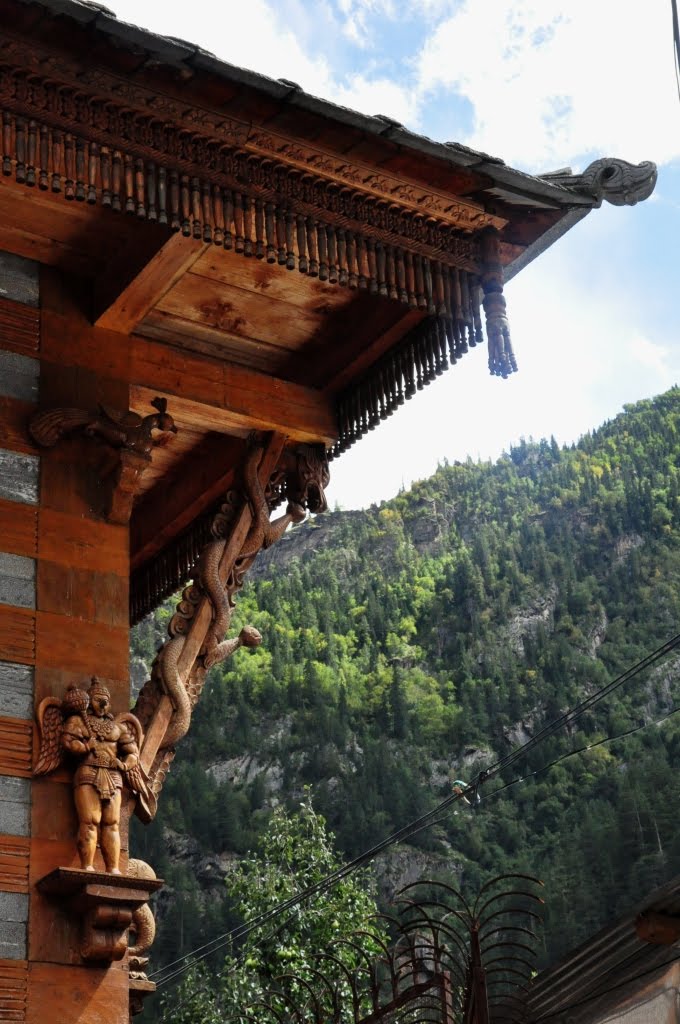
The temple at Batseri would have Durkheim in a twist. This temple has a soaring pagoda roof, far more curvilinear than any seen in Kinnaur so far. The urban eye, long espousing the belief that the sacred should somehow be spartan and spare in its expression, is startled by the curlicues, the ellipses, the festoons anf fixtures of the temple. If it weren't so reverential, the embellishment on the temple would be deeply comic, including as it does a vast range of divinities not normally seen in this part of the country. Dragons compete for space with elephants, Swami Vivekananda rubs shoulders with Ram and Shiva. There are spires and shikharas and entire constellations bedecking its walls.
More than the temple, however, the display of religiosity comes from a simple village celebration. This ceremony involves a ritual - and routine - ''airing" of the Gods. A group of the chosen - all men - carefully place the idols of the "devtaas" on a palanquin of burnished wood. Outside, the temple band has been variously thumping and blowing into its intstruments. As soon as the band espies the Gods, it sets a cacophony. Every possible sound that can emerge from the pipes, the drums and the cymbals does so with a great deal of gusto. The women watch from a distance and clap encouragingly. Children dance around the idol. The palanquin is reverently set up on a trestle. The pandemonium of the music lasts for a while, until, after another ritual circumnavigation, the Gods are taken back into the temple and set to rest.
This, then, is another wonderful example of hierophany... a sort of breakthrough of the sacred into the mundane human existence. This, to me, appears sacrality temporarily transcending the humdrum, elevating the human spirit. Every fragment of this experience is cosmic, and reveals a divinity to those whose eyes are yet innocent of urban sophisticated thought.


8 October 2009

A towered citadel, a pendant rock, a forked mountain...


Travel into the heart of Kinnaur and it is inevitable that you find yourself at Sangla, an edgy little town ranged along the Baspa. The settlement has little to recommend for itself, except a sort of ubiquitous Kinnauri prettiness and a huge mountain which, my local companion explains is "the back-side of the Kinner Kailash", that last being one of the tallest peaks in these parts.


The greatest find in Sangla is the lovely old fort of Kamru. Locals are incertain of its provenance, claiming it to be anything between four to seven hundred years old. It is a structure found commonly in Himachal. A tall wooden building, several stories high, so located as to serve as both a fortification and a look-out point for the village.
The climb up from the village is a steep one,. If you find it difficult to breathe, blame it not just on the steep incline, or the low levels of oxygen in the mountain air, but on the views all around which take your breath away! Just look at this magnificent fortification. It is designed to inspire awe in the manner in which it forces the viewer to crane her neck and make her eye travel upwards!


At the entrance is an imposing gate. This is made of old wood, embellished with a gorgeous motifs made in beaten metal of some sort, probably copper. The vagaries of the sun, the snow and the wind have burnished the copper into most attractive shades of titian, russet and henna. The visitor must take his shoes off at the entrance and put on a Kinnauri cap and a sort of string-like belt as a mark of respect to the royalty and the presiding deity.
Tall visitors are warned: the door in the picture above is designed to make you lower your head as you enter! Also, the fort doors are open only for a fxed while in the morning. So, should you be interested in exploring the fort, make sure you present yourself at its portals no later than ten o'clock in the morning.


What you see above is the little structure through which the visitor emerges having passed through the imposing doorway of the Kamru citadel. Some interesting musical instruments hang from sundry nails on its walls, unintentionally creating a fabulous Manetesque, still-life like effect.


Directly to the left as you enter lies this tiny hut. Evidently, it is a storage space for the palanquin of the presiding deity. It is on this palanquin that the deity goes for an "airing". I do not mean this in levity. Through a medium, locally known as a "ghoor", the deity has been known to express a desire to go visitng her siblings and friends in neighbouring villages; thus occasioning much celebration and gaiety.


The deity of Kamru, Kali, is much feared locally. Several bloodthirsty fables are attributed to her. Most important of all is the local concept of "darohi" or treachery. Legend has it that the Raja who ruled from Kamru demanded vassalage from all the thakurs (headmen) of surrounding villages. One day, finding himself encircled by Tibetan, he sent out frantic messages requesting support from his vassals. However, he was betrayed by a thakur and a local tailor from the village of Chini who told the Tibetans a way by which the ramparts of the Kamru fort could be brought down.
The Tibetans, and indeed the traitors, had not reckoned with the powers of the deity which were ranged alongside Kamru's ruler. Those supernatural powers and the mundane reality of approaching winters, made the Tibetans abandon their plans and at length, the Raja was able to chase them out of the valley.
This episode, however, left a bad taste in the royal mouth. And so was born the concept of "darohi", or treachery. The recalcitrant thakur was reduced to vassalage and the tailor, poor man, lost his head!
The Raja then ordered that a representative of Chini village be present every year at the eight-day festival held in honour of his deity. The poor man is then plied freely with liquour until he's fairly senseless. He is then dressed up in a mock armour and made to perform a sort of burlesque before the assembly of Kamru's residents. The idea is to make the village of Chini a laughing stock and to parody the treacherous actions of the thakur and the tailor. Water is then sprinkled over the head of this representative in a symbolic representation of his "beheading".
To be sure, people from Chini told me that no one wants to participate in this mock ritual which keeps the memory of their traitorous ancestor alive. On their part, the Rajas who ruled Kamru (of the Rampur-Bushahr line) have eased things by allowing waterto be poured over the representative's hands, instead of his head!
The concept of "darohi", however, is alive and kicking. Acting like an oath of loyalty, today it ensures obedience of the rule of law.

19 September 2009

Moulded to some heavenly norms

An avowed anti-religious monument, anti-ritual person, I have already confessed to my abiding affection for Himachal's temples. But every now and then, I am brought up short. I stumble upon some structure, some pantheon, or tabernacle which reminds me of all the things that are so wrong about the Hindu faith.
The Bhimakali temple in Sarahan is one such place. Seen objectively, it is a not unattractive structure. It has the square shape structure, surmounted by a three-layered, pagoda-like roof typical of this region.
The "shikhar" or the top of the temple is embellished with a lotus, sun and sunburst motif. It is also festooned by half-moons and six-pointed stars which remind my companion of Islamic and Jewish motifs!

It would be wrong to blame the temple. It is merely a case of the temple's managers being (literally) more loyal than the king. In their zeal to prove that this is the most important relgious building in the region, nay, the state, they have applied the spit and polish routine so ardently as to have robbed the temple of the friendly homeliness which endears the viewer to similar structures elsewhere. The gorgeous wood has been polished with an alarmingly yellow-tinged varnish. While I'm not aware of the effect this synthetic application has on old wood, it does not seem a good thing even to my lay-person's eyes.
The interiors resemble a well-appointed (Public Works Department) guest-house, with the wholly-inappropriate marble floor covered in jmaroon and green jute matting and the wooden bannisters painted a snowy white. The poor deities look terrified, locked up behind huge steel bars in the sanctum sanctorum.

My distaste for this temple is further bolstered by the presence of that other entity I so cordially detest: the temple priest. The one in the Bhimakali temple runs to type. An insensitive motor-mouth, he assumes that my companion and I are not only ignorant of Hindu mythology (we are not), but also that we need a crash course right there and then. We are made to sit in the inner sanctum and out pours a lurid sacerdotal tale of lust, envy, anger and revenge. We both squirm, yawn politely and then, finally just resign ourselves to a boring afternoon's story-telling. Our plight is not very much improved by our lack of monetary offerings to this already apparently prosperous deity.

The irksome narrative is thankfully livened up the appearance of the creature in shining armour! We focus on its antics instead and come out breathing in relief.

18 September 2009

Full of sound and fury

but, like the Bard, I won't say it signifies nothing!


When the rains burst upon Kinnaur where I was travelling last week, I realised for the first time in my life that in the vast dome of nature, there reigns a sort of controlled violence! There's a domineering fury entirely capable of hurtling all living beings into a common doom. It is as though the decree of violent death is inscribed on the frontiers of life, far away from the cocooned life of a householder.


Interestingly, the fury of the thunder exhausts itself in time and leaves the air calm and utterly serence in its wake. If only human anger could be like that!

7 August 2007

Digression

Digression: wandering from the main path of a journey; turning aside (of your course or attention or concern); a message that departs from the main subject.

This blog has so far been only on Shimla. But late in July, I went travelling through Kinnaur & Spiti. This was a God-sent (or shall I say, government of India-sent) opportunity to re-visit the place of my dreams - Chandrataal.

Over the next few days I hope to post pictures of some of the places I saw on my way. I would like to talk about so many things I saw on my way - the constant play of sun and clouds, of light and shade, the aridity, the fertility, the cold, the warmth, the deserts, the lakes, the firendly lamas & zomos, the gompas, the innumerable chortens, the lonesome mummy at Geo, the tsampo, the salty tea, the improbable chocolate croissants discovered at Kaza, the laughter, the sheer joy of being on the open road....


This sight of the sun rising slowly over the mountains at Recong Peo reminded me of a Roerich painting.
The sublime view of the mountains is balanced by the sheer ugliness of the town with its higgledy-piggeldy buildings, open drains and the fine sheen of dust that seems to cover everything!
Related Posts with Thumbnails