Why this blog is called "Gallimaufry".

gal-uh-MAW-free\, noun.

Originally meaning "a hash of various kinds of meats," "gallimaufry" comes from French galimafrée; in Old French, from the word galer, "to rejoice, to make merry"; in old English: gala + mafrer: "to eat much," and from Medieval Dutch maffelen: "to open one's mouth wide."

It's also a dish made by hashing up odds and ends of food; a heterogeneous mixture; a hodge-podge; a ragout; a confused jumble; a ridiculous medley; a promiscuous (!) assemblage of persons.

Those of you who know me, will, I’m sure, understand how well some of these phrases (barring the "promiscuous" bit!) fit me.

More importantly, this blog is an ode to my love for Shimla. I hope to show you this little town through my eyes. If you don't see too many people in it, forgive me, because I'm a little chary of turning this into a human zoo.

Stop by for a spell, look at my pictures, ask me questions about Shimla, if you wish. I shall try and answer them as best as I can. Let's be friends for a while....

Showing posts with label Himachal's temples. Show all posts

16 June 2010

Sacrifice is nothing other than the production of sacred things


My journey to Ani had been uneventful, bordering on the boring. For one thing, a road-block at Theog had forced me to back-track up to Basantpur and make a detour via Luhri which was hot, hot, hot. Ani itself was unspectacular, constructed along the highway, all it had to show for itself was a row of really unattractive shops. I couldn’t wait to move on to Khanag where the memorial plaque for Penelope Chetwode (I’ve written about this earlier) waited to be explored.

At the guesthouse, I bumped into some men who work for the Public Works Department. Anything interesting to be seen in these parts, I asked them. Well, there’s a little temple at Shamshar. Nothing great, you see. But it’s not bad. Considering that I’d been starved for any sort of cultural relief, I grabbed at this opportunity. The men were headed the same way and agreed to go with me to show me the temple.

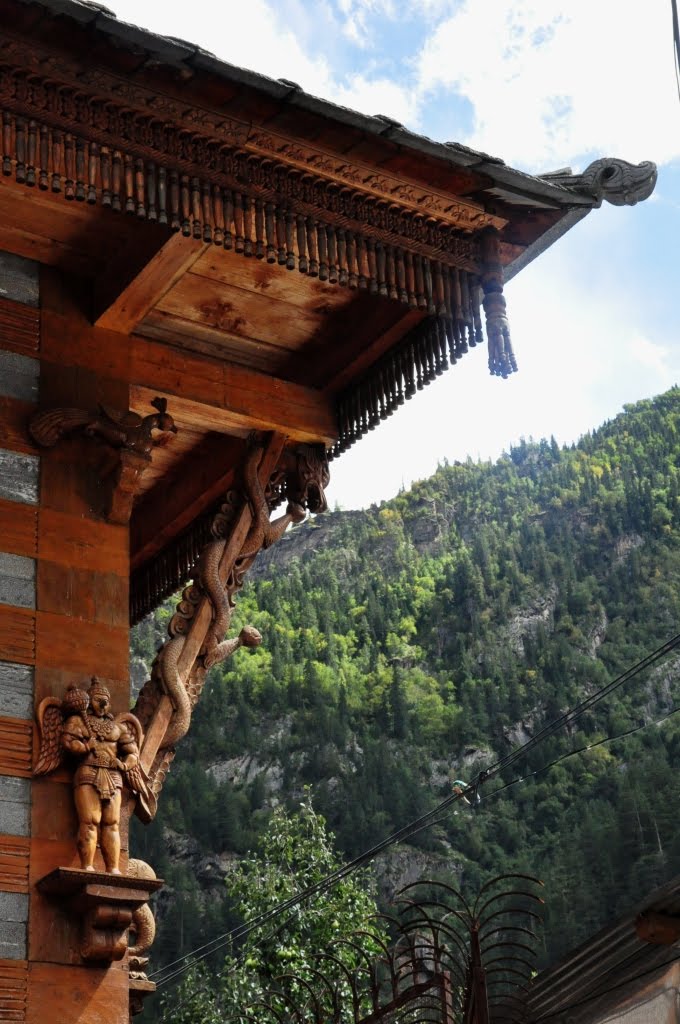
I won’t go into a detailed description of the temple as is my wont. It was a typical Himachali temple: chalet and spaceship rolled into one, quaintly attractive, unobtrusive and tremendously colourful. There were two taller structures behind it. One squat, painted white and embellished with the most attractive wood carvings you ever saw. The second was built in the typical “dehra” style. A tall building topped off by a pagoda-style roof, painted in candy shades. This temple was draped with a huge rope whose diameter was thicker than my wrist. Idly, I asked one of the PWD men if Himachal had a tradition of people physically pulling the Gods’ chariots with these ropes. Oh, no, no, he said. And thereby hung a tale. I am going to recount it almost as he told me.

It is said that on the orders of his father Jamadagni, Parshurama had killed his mother Renuka. When asked what boon e would like for this act of extreme obedience, Parshurama begged his father to bring his mother back to life. However, he needed to expiate the sin of matricide, so he donated land to the Brahmins of Nirmand and deemed that a “yajna” every three years and “bhunda” (human sacrifice) every twelve years.

The person who offers himself as sacrificial victim is called “beda” and comes from a community of people which has, for generations, offered one of its members for this purpose. He is required to plait a rope over 500 metres long. This rope will play a very important role in the “bhunda” ceremony. During the fifteen days preceding the “bhunda” ceremony, the “beda” is fed and clothes at the expense of the temple and is associated closely with the goddess as he is no longer seen as one of the human race.

The rope the victim has plaited will be slung out over a cliff and the “victim” will have to slide down this rope. Should he be fortunate enough to survive this slide, his life is spared, but in the old times, death must have been a certainty. Hundreds of devout volunteers carry the rope which has been carefully plaited by the “beda” to the site where the “sliding ceremony” will take place. Meanhile, the “beda” is taken to the temple and formally dedicated to the goddess Ambika. Draped in a shroud, he is carried to the sacrificial site by other devotees. Weighed down by sacks filled with grain and/or sand, he is made to walk on the rope.

As I’ve said above, death is a certainty, but there is insurance for his widow. When the “beda” is dead, his widow is allowed to select any of the items she sets her sights on. Whatever she touches is hers that day. In this way, tradition ensures that she is not left destitute by the demise of her husband.

So important is this ceremony that Gods of neighbouring areas specially visit Shamshar in full ceremonial regalia. They are taken out in a procession their path lit by huge flaming torches. An interesting aside to this event is that a sacred water vessel belonging to Parshurama is brought out especially for this occasion. Water in this vessel is replenished by a sacred spring in the village. Legend has it that the spring appears only the year “bhunda” is held. It remains dry, indeed, invisible for the entire period when Parshurama is in retreat.

Once the ceremony is over, all ritual articles and the image of Parshurama are taken back to the shrine. The visitng Gods depart for their homes, taking with them the masses of curious, innocent villagers who had come to witness this unique ceremony; the massive doors are bolted, not to be opened for a further twelve years.


26 March 2010

Some lovely Temple, Tenantless...

My wanderings in Shimla's surrounds have revealed an unexpected treasure trove of temples. It is interesting how quickly word spreads when you reveal an interest to your circle of friends. There you are, sitting with your fingers wrapped around a cuppa, saturated with postprandial bliss, when someone says "G, you simply have to go to X, or Y or Z!". There's little to do but oblige! The trip to Balag was the result of one such evening, and the provocation came from my revered friend B. S. "Billy" Malhans who is an authority on the temple architecture of this wonderful state.

There are three temples in Balag, a small village in the sub-division of Theog. Two are of the rock-cut variety and one built in the old "devra" style which is my personal favourite. As with many temples in Himachal, this temple too has legends connected with the famous Hindu epic, the Mahabharata. What is more interesting is that in Balag, mythology surrounding the Hindu deity Shiva has got inextricably linked to the allegories related to Mahabharata.


The most important temple is dedicated to the divine destroyer, Shiva. The temple displays all the motifs and symbols connected to his apologue. Nandi, the divine bull, guards the entrance to the temple. The shikhara, the rising tower which covers the sanctum sanctorum, is bedizened with his emblems, weird animals and grinning ganas, his attendants or ghostly hosts, on account of their nature.These are supposed to be of ghostly origin and generally benign except when someone transgresses against their Lord.


The temple is built of blocks of sandstone some of which are coming sadly undone. There is a huge vertical crack running through the northern end of the "shikhara" which could prove catastrophic in the future. The temple's "kaardars" (keepers) say they have knocked on several doors, but to no avail.


Ganesha, the son of Shiva is a deity beloved of Hindus, for it is his name that is invoked before the commencement. He stands for a heightening of every sense and of pursuit equally of knowledge as well as good food! I saw a small stone statue of his in Balag, resting separately from the temple in its own niche. The provenance was of the same era as the main temple. The statue had suffered the depredations of time, its surface worn smooth, yet still revealing Ganesha's elephant ears (symbolising wisdom), his pot-belly (symbolising a huge apetite) and long trunk (which stands for heightened sensory perception).
Similarly, there are small staues, no more than eighteen inches in height of Shiva and his divine consort Parvati ("Daughter of Mountains"), and of Shiva as "Mahadeva" the Supreme Soul.

Among several of his anthropomorphic forms, Shiva is also represented in the shape of a vertical rounded column. Regarded by some as the phallic symbol, worship of the lingam actually originates in the Atharva Veda in the praise of the sacrificial post: the Yupa Stambha.
Standing close to him is Nandi, his divine mount, another symbol of Shiva being the Lord of Animals.


T little temple in the picture above was the second in the little triad. This temple is dedicated to Nakul, one of the five Pandava brothers and twin borther of Sahdeva. It is embellished most attractively on the face of its little "shikhara" (temple dome) with the face of a figure not unlike that of Pashupatinath ("Lord of Animal-like Beings"). Surrounding this are gorgeous floral and lacy patterns, wrought delicately in stone.


This is the oldest devra of Balag, which, while not de-consecrated, no longer sees regular worship. As can be seen, it looks to be of an entirely different age and design than the other two temples.

12 March 2010

The very temple of Delight...


About 50 kilometres from Shimla stands a little village called Chikhad. This is in the Theog sub-division and is localed in a valley off the National Highway. Rushing on his hasty way from Shimla to Rampur, the average traveller is unlikely to spot this village. It is but another Himachali village with its big and little wooden houses, its fields and hayricks and, of course. its temples. From a distance, you would think you are looking at a little model of a village created by a particularly skilful child.
This is a set of three temples. Clearly, they have been built at different times, by different people, and have received varying degrees of attention from the locals.


What you see above is temple number one. Built with the typical pagoda roof and standing about four floors high, this one is home to the youngest deity. It was most intriguingly adorned with a decaying stuffed head of a huge antelope. The antelope's expression was not unlike that of Miss Havisham's in "Great Expectations"! This temple bore all the traditional bells and whistles seen in other temples: there are little dangling wooden pieces, swaying and twirling in the breeze. Little pillar-like objects join the wall to the ceiling, bearing a really attractive likeness of men in worshipful poses: knees bent, palms folded. A little wooden ladder, about as wide as your average laptop bag, ascends to the sanctum sanctorum. The structure is edged by a pretty floral pattern.


The second temple is a small wood-and-stone one. A helpful local tells me it has been at the receiving end of the local politician's attention. Hence, the excessively polished "PWD" look... What I liked best about this temple was its roof. Constructed in the pagoda-roof fashion, its shape is strongly reminiscent of those little umbrellas which come with a cocktail drink! Its candy stripes only embellish that look further.
A feature that emphasises its recent renovation is a large ''om'' that is carved into its door. In older Himachali temples, one is unlikely to come across overt Hindu motifs. In fact, the designs are remarkably catholic and universal in their shapes and forms and are either geometric or floral.


The third and oldest temple is the one that is the most captivating. A squat structure, it recomends itself strongly to passing off as a vehicle of an alien invasion. Something that flew in from the skies one day and found its rest in the hills. Golden, purple, azure shadows break up and crisscross on its floors. A little pink platform bears up the entire structure and slanting wooden pillars, painted a happy green rise to the tiny roof.


Inside the temple you see a pandemonium of colours. Every imaginable aspect of the spectrum marks its presence in the patterns. Humans jostle Gods who rub shoulders with animals and birds. Some gods looks angry and vengeful as they smite demons with sharp weapons. Others bear a joyous aspect and frolic and dance with their divine companions. Each wears rich fineries and elaborate jewellery. The menfolk bear fierce-looking arms: bows, arrows, spears and maces. Some are seen astride horses. The womenfolk are dressed in long skirts and wear lovely trinkets: bangles, anklets, nose-rings, necklaces and all sorts of adornments in the hair.
There is a multitude of scenes from Krishna's life. From his childhood, filled with naughty tricks. His slaying of the snake-demon Kaalia and his frolics with an army of Gopikas.
The temple is also adorned with scenes from the Puranas. Each of the ten avtaars assumed by Vishnu are lovingly represented here. The elaborate details are at once mesmerising and humbling, for yet again, for all the huge quantity of loving attention and hard work they have put in creating these decorations, you find no allusion to their creator or creators. The only thing the artistes have left behind are thousand upon thousands of abstruse images depict the lives and times of a swarm of deities.


A happy calm prevails. No step disturbs the peace of the temple. The holy fire on the altar has long been quenched. No voice bursts into joyous prayer, nor does a sigh rise to the heavens. No precious incense rises like the balm offered by a good person's litanies. But this temple gives you the feeling that a grateful song, a fervent prayer would surely rise to the heavens and find acceptance there.

14 January 2010

The climate's delicate, the air most sweet, the temple much surpassing the common praise it bears

The road From Shimla to Rampur snakes its way from Cart Road, passing the suburbs of Sanjauli and Dhalli. It winds its way through the evergreen forests, skirting the wonderful Catchment Forest of Sheogh. En route fall those two ugly, concrete-covered tourist traps of Kufri and Fagu. Also on this road, you find some enterprising fellows who have set up shop - for tourists with a penchant for having themselves photographed in ''local dress". (It's a different matter that no local would ever recognise these outfits, much less be caught dead in them!)


This road wends its way past the truly unattractive town of Theog. You'd be forgiven for driving past it without a second look. But then, you'd be missing a little gem of a village which lies just a kilometre outside Theog. The place is called Janog. I found a pair of lovely temples. One all done up in candy colours, now fading to a nicety; the other, a typical wood and stone structure, its stone and wood attractively ageing thanks to the elements of nature.


The "younger" temple is that of Chakreshwar, a local deity. It is a pretty, two-storeyed structure currently squeezed between the homes of the inhabitants of Janog. Like many I've seen in Himachal, it has attractive embellishments: beautiful floral, curlicue patterns edging its sides. As always, wooden tassles, alternately coloured pink, blue, yellow and white, dangle and sway in the light breeze. Also as in Himachali temples, one has to rest content with looking at the structure from outside as noone but the temples caretakers are allowed inside.
The local pujari informs me that Sankranti, a festival falling on 13th January, is an important one for this temple. This is the day when the Gods are taken out to meet the devotees. This confluence of the sacred and the secular is an intriguing one, especially since the presiding deity is expected to troubleshoot on behalf of the devotee. The diwaan of Janog informed me that usually a goat is sacrificed on the occasion, not on the express wish of the deity, but so as to allow the locals to enjoy a hearty celebration meal afterwards!


What you see below is the "older" temple, or the deora. Hindu temples are never de-consecrated, so to that extent this remains a holy spot. However, locals have long since abandoned it in favour of the newer version. It has a little place for the homa, the sacred fire lit for special prayers, and while parts of it are still cheerfully coloured, it wears the slightly folorn look of someone whose time has passed. Devout men and their religious texts do not sound a canting peal in its walls, yet, there is a sense of the resting of spiritual oars here.


This is the frontal aspect of the temple. This is yet again, a pretty example of the attractive sloping-roof style with its typical projecting horizontal pillar.


The roof is graven with a thousand images of joyous celebration, men and women holding hands as they dance to the tune issuing from myriad musical instruments.


The pillars and the cross-beams hold faith firm and encircle the temple sanctum with affectionate gravity. There are no walls to shut out the clamour of the outer world and direct the mind to higher realms. Yet, the mundane and the sacred meld into one here.


8 January 2010

A magic web with colours gay

What you see below is a temple I found in a place called Kunihar, not far from Shimla, thanks to my friend Dr. Usha Bande. Loved its psychedelic colours and the dizzy joy in the candy-coloured lines and dots. Ever so often, we seem to forget that religion is not just a space of solace, or redemption, but also of merriment, felicity and the celebration of God's benediction.


By the lamplight stall I loitered, feasting my eyes
On colours ripe and rich for the heart's desire —
Tomatoes, redder than Krakatoa's fire,
Oranges like old sunsets over Tyre,
And apples golden-green as the glades of Paradise.

And, as I lingered, lost in delight,
My heart thanked God for the goodly gift of sight
And all youth's lively senses keen and quick...
When suddenly, behind me in the night
I heard the tapping of a blind man's stick

~ Wilfrid Wilson Gibson ~


16 November 2009

A great and sacred blessedness


As a person profoundly distant from religion and religiosity, my brush with faith at Batseri was a curious and a humbling one. Having decided to make Sangla my base, it was only natural that Chhitkul should beckon. However, as Lalchand the faithful charioteer made his way up the mountains, an interesting sight opened itself in the distance. Nestled in the midst of the greys and the green and the azures were some peculiar pagoda-like shapes. It was only logical that a detour be made to explore these shapes.
A treat lay in store.
The temple at Batseri would have Durkheim in a twist. This temple has a soaring pagoda roof, far more curvilinear than any seen in Kinnaur so far. The urban eye, long espousing the belief that the sacred should somehow be spartan and spare in its expression, is startled by the curlicues, the ellipses, the festoons anf fixtures of the temple. If it weren't so reverential, the embellishment on the temple would be deeply comic, including as it does a vast range of divinities not normally seen in this part of the country. Dragons compete for space with elephants, Swami Vivekananda rubs shoulders with Ram and Shiva. There are spires and shikharas and entire constellations bedecking its walls.
More than the temple, however, the display of religiosity comes from a simple village celebration. This ceremony involves a ritual - and routine - ''airing" of the Gods. A group of the chosen - all men - carefully place the idols of the "devtaas" on a palanquin of burnished wood. Outside, the temple band has been variously thumping and blowing into its intstruments. As soon as the band espies the Gods, it sets a cacophony. Every possible sound that can emerge from the pipes, the drums and the cymbals does so with a great deal of gusto. The women watch from a distance and clap encouragingly. Children dance around the idol. The palanquin is reverently set up on a trestle. The pandemonium of the music lasts for a while, until, after another ritual circumnavigation, the Gods are taken back into the temple and set to rest.
This, then, is another wonderful example of hierophany... a sort of breakthrough of the sacred into the mundane human existence. This, to me, appears sacrality temporarily transcending the humdrum, elevating the human spirit. Every fragment of this experience is cosmic, and reveals a divinity to those whose eyes are yet innocent of urban sophisticated thought.


19 September 2009

Moulded to some heavenly norms

An avowed anti-religious monument, anti-ritual person, I have already confessed to my abiding affection for Himachal's temples. But every now and then, I am brought up short. I stumble upon some structure, some pantheon, or tabernacle which reminds me of all the things that are so wrong about the Hindu faith.
The Bhimakali temple in Sarahan is one such place. Seen objectively, it is a not unattractive structure. It has the square shape structure, surmounted by a three-layered, pagoda-like roof typical of this region.
The "shikhar" or the top of the temple is embellished with a lotus, sun and sunburst motif. It is also festooned by half-moons and six-pointed stars which remind my companion of Islamic and Jewish motifs!

It would be wrong to blame the temple. It is merely a case of the temple's managers being (literally) more loyal than the king. In their zeal to prove that this is the most important relgious building in the region, nay, the state, they have applied the spit and polish routine so ardently as to have robbed the temple of the friendly homeliness which endears the viewer to similar structures elsewhere. The gorgeous wood has been polished with an alarmingly yellow-tinged varnish. While I'm not aware of the effect this synthetic application has on old wood, it does not seem a good thing even to my lay-person's eyes.
The interiors resemble a well-appointed (Public Works Department) guest-house, with the wholly-inappropriate marble floor covered in jmaroon and green jute matting and the wooden bannisters painted a snowy white. The poor deities look terrified, locked up behind huge steel bars in the sanctum sanctorum.

My distaste for this temple is further bolstered by the presence of that other entity I so cordially detest: the temple priest. The one in the Bhimakali temple runs to type. An insensitive motor-mouth, he assumes that my companion and I are not only ignorant of Hindu mythology (we are not), but also that we need a crash course right there and then. We are made to sit in the inner sanctum and out pours a lurid sacerdotal tale of lust, envy, anger and revenge. We both squirm, yawn politely and then, finally just resign ourselves to a boring afternoon's story-telling. Our plight is not very much improved by our lack of monetary offerings to this already apparently prosperous deity.

The irksome narrative is thankfully livened up the appearance of the creature in shining armour! We focus on its antics instead and come out breathing in relief.

1 September 2009

Religion is the frozen thought of man

There's a little village called Kao (pronounced "cow") about 7 kilometres from Karsog. The drive from Karsog is an interesting one, as it skirts the edge of the valley and offers enchanting panoramas of the jade and emerald dales spread out before you.
The temple of Kamaksha Devi is, in a sense, not unlike the almost pagoda-like structures you see elsewhere in Himachal. There are two structures. Approaching from the main road, you are likely to come up to the first and the bigger sanctum.

This one has sloping, slated roof on three, or almost four levels. Lovely little wooden cylindrical thingumajigs hang in lacy detail from its edges. They bob and sway in the gentle breeze.


The combination of mud, plaster and wood creates magic once again. The geometry of this 10th-century structure is hard to understand, but so very easy to extol. It is austere and ornate, artless and embellished at the same time. I circle it and circle it again,searching for some flaw, some little error. But the eurhythmy remains unbroken.


At the risk of sounding like a broken record, I am constrained to say yet again that the older "dehra" (the tall equilateral building you see above) is far more attractive in its Spartan look. I love its geometry. Its colours, weathered to mellow amber, beige, sepia, bronze and sorrel; its wood a deep mahogany here, a burnt sienna there with lots of cinnamon in between.


Inside, there is a disarray of objects religious: bells, drums, incense-holders, lamps, stale flowers. The priest is nowhere in sight, so one is deprived of the history of the place. Obviously, this deity bears some relation to the one in Assam, but we remain ignorant in the absence of those who know. Traditionally, this incarnation of the female deity Shakti represents the Goddess in her more violent, vengeful aspect. The idol kept in the sanctum, however, bears a benign expression. She bears her usual arms, the axe and the sword, but her right hand is raised in benediction. She is surrounded by adoring angels and lesser deities.


The slate roof is silvan, ashen and pearly by turns. The wooden pillars contrast most attractively with it.


The temple has a series of these carved wooden panels embedded into its walls at eye level. The images represent a number of members of the Hindu pantheon, all engaged in activities they're usually famous (or infamous) for. Hindu deities are notoriously human in their follies and foibles, but perhaps this is what makes them tolerant and forgiving towards their worshippers, and, in turn, earns them a great deal of personal affection.

31 August 2009

Mamleshwar

As I've said earlier, most Hindu temples leave me cold. Some of these have a peculiar soullessness that stands in stark contrast to their apparently pious air! Or maybe the two are not entirely irreconcilable, after all hypocrisy has long been the preserve of religion.
The temple at Mamleshwar left me distinctly underwhelmed. It is not the temple's fault - I attribute it to concrete. This temple is like many others you'll find all over Himachal. Yet, what it lacks is that pristine quality of unsophistication, that almost puritanical aspect, which, for me, has become the singular facet of this wonderful state's buildings, be they tiny forts or places of worship.


This temple suffers the fate of many of its brethren elsewhere. The old "dehra" (temple) has been relegated tothe background. The lovely old wood and slate and stone structure has been covered with vast layers of ugly concrete, painted over in cheap oil paint. The old images, almost pagan in bearing, have been replaced by the more generic North Indian idols, robbing them of any consonance with local culture. Many of the old deities graven in stone have been pulled out of their original places and embedded into concrete, making them look utterly ugly and out of place. The temple walkway is covered with marble, a stone which looks admirable in warmer climes, but is unsuitable in look and use in Himachal.


The temple priest wears the greedy air typified by his ilk all over India. He is unshaven, and most likely, unwashed. His five o' clock shadow takes nothing away from the general air of decay that surrounds him. He has been lolling on a reed mat, watching TV (thankfully, one of those loony religious channels) but bustles around officiously when he spots our party advancing upon the temple. He insists we perform rituals, but on finding no encouragement, sulks in a corner.


Facts: Mamleshwar is in Karsog tehsil, about 95 kilometres from Shimla. The drive to Mamel, from Chindi via Karsog where the temple is located is really beautiful. Visit the temple if only to tick it off your list!
Related Posts with Thumbnails